Enzyme for Soy Protein Structuring in Meat Analogues
Soy protein is productive, familiar, and scalable — but it is not forgiving. In meat analogue manufacturing, small shifts in hydration, shear, heat history, salt, oil, and protein quality can move the finished texture from fibrous and resilient to weak, rubbery, dry, or crumbly.
Enzymefusion develops enzyme systems for soy-based plant protein formats where structure must hold through mixing, forming, extrusion, cooling, packing, and reheating. We work with R&D, process development, and technical purchasing teams that need controlled protein interaction — not a generic texture aid.
If you need an enzyme supplier for plant based meat manufacturing with soy-specific formulation discipline, Enzymefusion supports targeted trials, scale-up alignment, and quote-ready supply planning.
Request a quote using the on-site form
Built for soy texture failure modes
Soy behaves differently across isolate, concentrate, textured soy protein, high-moisture extrusion blends, hydrated chunks, and comminuted analogue systems. The same enzyme strategy rarely works across every format.
Enzymefusion focuses on the structural problems that show up in real plant-based meat factories:
- Weak gel formation after hydration or heat setting
- Crumble failure during forming, slicing, tumbling, or cooking
- Rubbery bite caused by excessive or poorly distributed protein binding
- Moisture loss during cooling, packing, pan-frying, or reheating
- Poor strand definition in soy-forward extrusion systems
- Inconsistent texture when protein lots or hydration behavior shift
- Fragile matrices with high oil, fiber, methylcellulose, starch, or flavor load
The objective is a controlled protein network that supports bite, strand integrity, and moisture management without flattening the eating profile.
What the enzyme system is designed to do
Enzymefusion soy protein structuring systems are selected and tuned to help manufacturers influence how protein networks form under process conditions. The goal is not simply to make the matrix firmer. The right system should improve the relationship between bite, cohesion, juiciness, and process tolerance.
Depending on the formulation and line design, the enzyme system may support:
- Stronger internal cohesion in formed patties, strips, nuggets, and minced formats
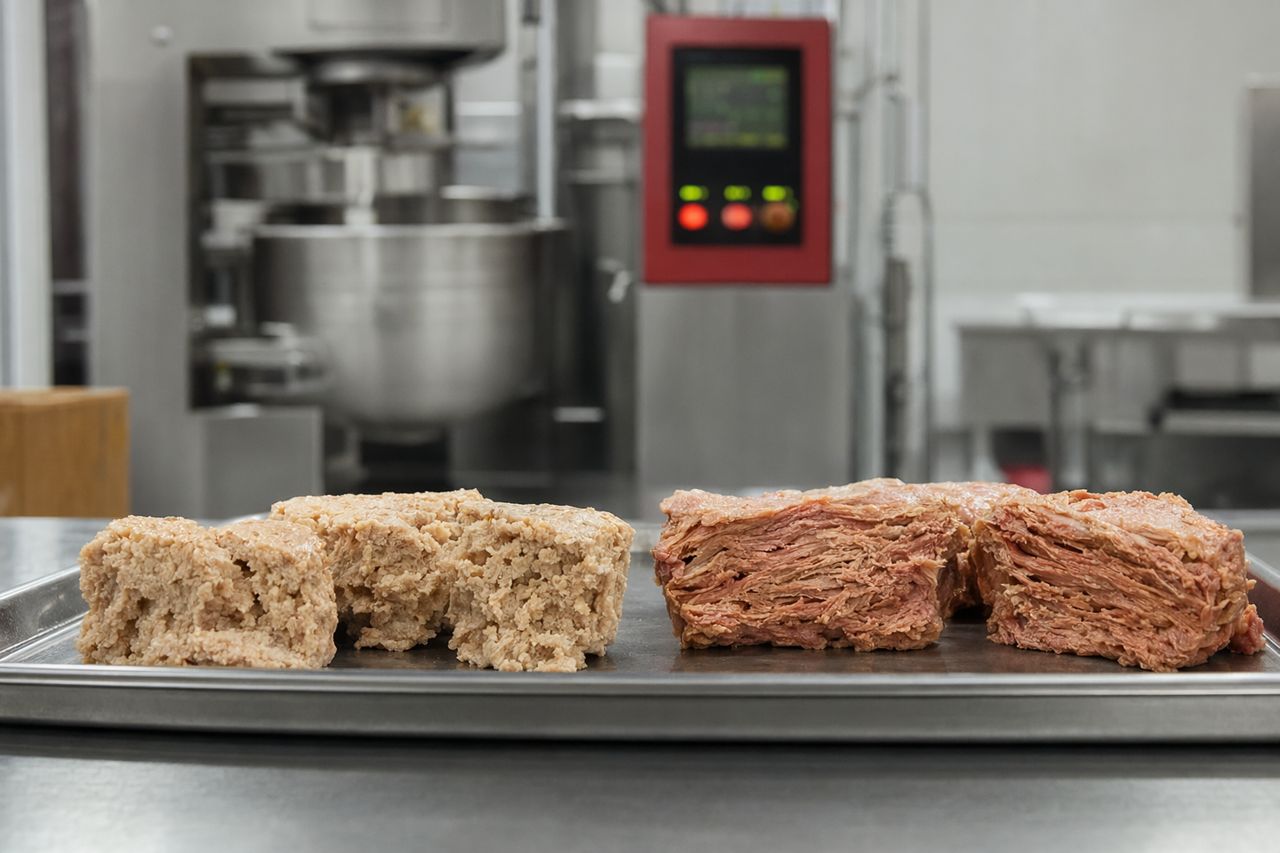
- Cleaner fibrous pull in soy-based high-moisture extrusion or structured blends
- Reduced fracture and edge breakage after cooling and cutting
- More stable water binding through thermal processing and reheating
- Lower dependence on over-building gums or starches to compensate for weak protein structure
- Better texture consistency across pilot, validation, and commercial runs
We evaluate the total matrix: soy protein type, hydration schedule, fat phase, fiber system, binder package, salt level, flavor load, pH range, shear profile, residence time, and thermal exposure.
For R&D teams moving from bench to line
Many soy texture concepts work in a small mixer and fail on the line. Scale-up changes hydration speed, shear distribution, temperature rise, hold time, and order of addition. Enzyme performance is directly shaped by those conditions.
Enzymefusion supports development teams with a practical trial structure:
1. Define the target texture
We begin with the finished product requirement: fibrous tear, minced cohesion, sausage-style snap, cutlet resilience, nugget bite, or crumble stability. Texture language is translated into process-relevant variables so the trial has a clear endpoint.
2. Map the soy matrix
We review the protein base, hydration method, oil and binder system, salt and seasoning impact, thermal profile, and any existing texture defects. This helps avoid over-correction, especially in matrices already close to rubbery or dry.
3. Select an enzyme route
The enzyme approach is matched to the process window. Some systems need early hydration exposure. Others are better suited to mixing, pre-conditioning, extrusion-adjacent steps, or post-formation heat setting. We do not force one route across all soy formats.
4. Validate under realistic handling
Texture is assessed after the stresses that matter: cooling, cutting, packing, freezing where relevant, thawing, reheating, and consumer-equivalent cooking. A matrix that holds only immediately after forming is not production-ready.
One-minute process explainer
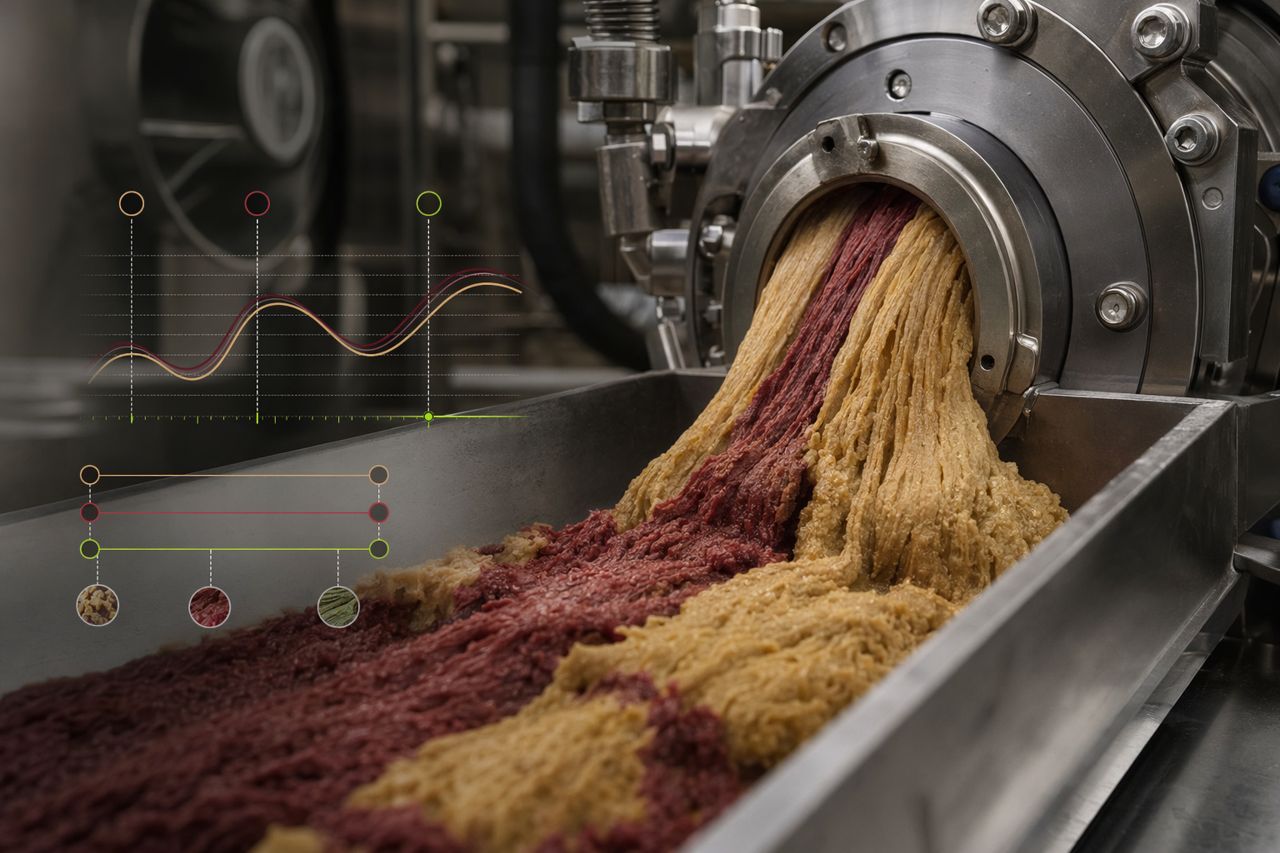
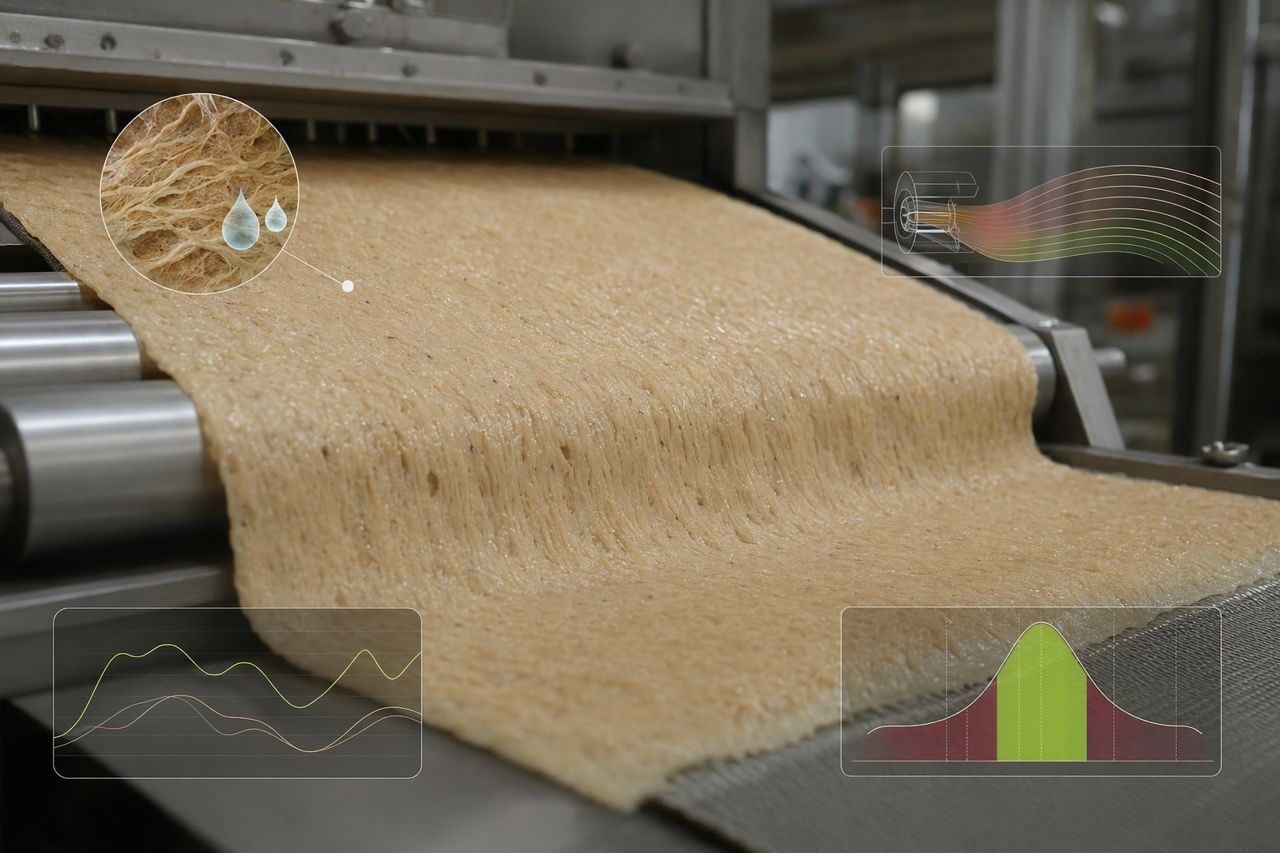
[Embedded faceless explainer video: soy protein strands forming under shear, with enzyme dose markers, hydration fields, rheology curves, and extrusion temperature readouts. Voiceover with on-screen subtitles. No avatar.]
The explainer shows how soy protein structure develops through hydration, mixing, shear, and heat — and why enzymatic structuring must be matched to the factory window instead of treated as a simple additive swap.
Applications in soy-based meat analogue lines
Enzymefusion enzyme systems can be evaluated for a range of soy-forward products, including:
- High-moisture extruded strips, chunks, shreds, and fillets
- Soy protein patties and formed mince systems
- Plant-based nuggets, schnitzels, tenders, and breaded formats
- Hybrid soy and pea protein matrices
- Sausage-style analogue systems requiring cohesive bite
- Ready-meal inclusions that must survive sauce, retort-adjacent heat, or reheating stress
For each application, the enzyme strategy is adjusted around the finished product target and the actual factory process. A high-moisture extrusion line, a cold-formed patty line, and a heat-set nugget line do not require the same structuring logic.
Why manufacturers choose Enzymefusion
Enzymefusion is built for industrial formulation teams that need decisive technical input before committing to scale. We focus on the link between ingredient function and manufacturable texture.
You can expect:
- Soy-specific enzyme selection instead of generic protein treatment
- Trial planning around your equipment, sequence, and process constraints
- Support for texture targets such as strand integrity, chew, slice quality, and crumble resistance
- Practical guidance on interactions with fibers, starches, oils, salts, gums, and flavor systems
- Quote preparation aligned to application, production scale, and supply expectations
We keep the conversation technical, direct, and oriented toward production outcomes.
Typical project signals
A soy structuring enzyme evaluation is often appropriate when your team is seeing one or more of these issues:
- Texture looks acceptable hot but collapses after cooling
- The product slices or dices poorly because the internal network is weak
- Moisture release increases after packing or reheating
- The matrix becomes tough when binders are increased
- Extruded strands appear visually defined but break down during handling
- Reformulation is needed due to protein source changes or cost engineering
- Pilot texture does not translate to the commercial line
These are not just formulation defects. They are interaction problems across protein quality, hydration, shear, heat, and time. Enzymes can be valuable when that interaction needs more precise control.
Request a quote
Tell us what you are making, which soy protein format you use, where the texture is failing, and what process window the enzyme must fit. Enzymefusion will review your application and recommend the next step for a quote-ready evaluation.