Freezing, Thawing and Texture Loss in Vegan Meat Products
Frozen distribution is often treated as a logistics decision. For plant-based meat factories, it is also a texture design problem.
A burger, mince, strip, nugget, or sausage analog can leave the pilot line with convincing bite, visible fiber, and controlled juiciness. After freezing, warehouse dwell time, thawing, and reheating, that same product may show sponge-like chew, purge, oil bleed, surface cracking, weak cohesion, or dry fracture. The formulation did not simply “lose freshness.” Its protein-water-fat network was stressed, expanded, fractured, and partially reorganized.
Enzymefusion supports manufacturers solving those failures at formulation and process level. As an enzyme supplier for plant based meat manufacturing, we focus on how enzyme systems interact with plant proteins, binders, extrusion history, hydration strategy, and thermal processing so texture survives commercial handling rather than only looking good at bench scale.
Why freeze-thaw cycles punish plant-based meat texture
Freezing changes the physical state of water first, but the damage is expressed through the whole matrix.
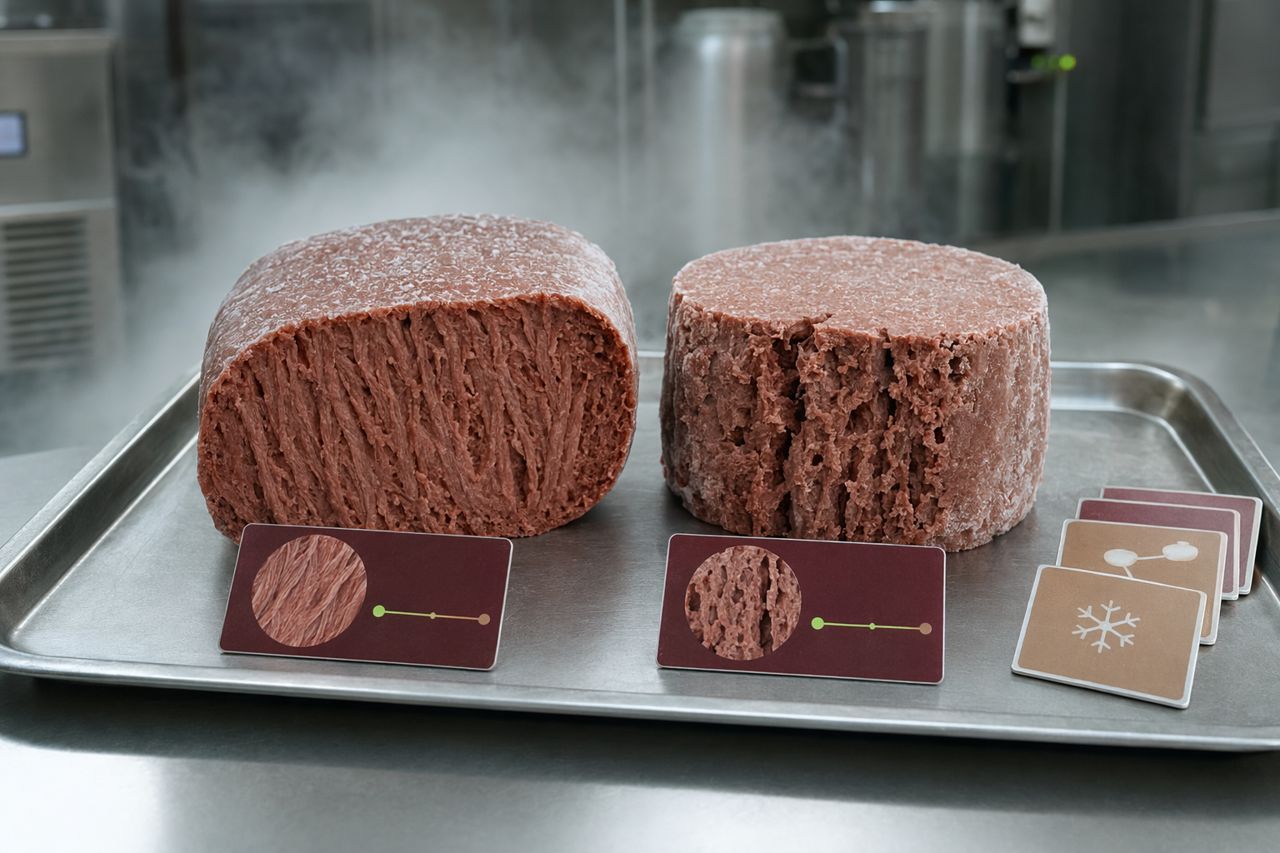
When free water crystallizes, it concentrates salts, soluble solids, proteins, hydrocolloids, flavors, and lipids into the unfrozen phase. Ice growth can push apart weakly connected protein domains, interrupt fiber alignment, and create channels that later become purge pathways. During thawing, water does not always return to the same binding sites. It can migrate to the surface, pool at package edges, or separate during cooking.
In plant-based meat, the issue is amplified by three common realities:
- Protein heterogeneity: pea, soy, wheat, fava, canola, mung, chickpea, and mycoprotein inputs vary in solubility, denaturation state, particle size, and water-binding behavior.
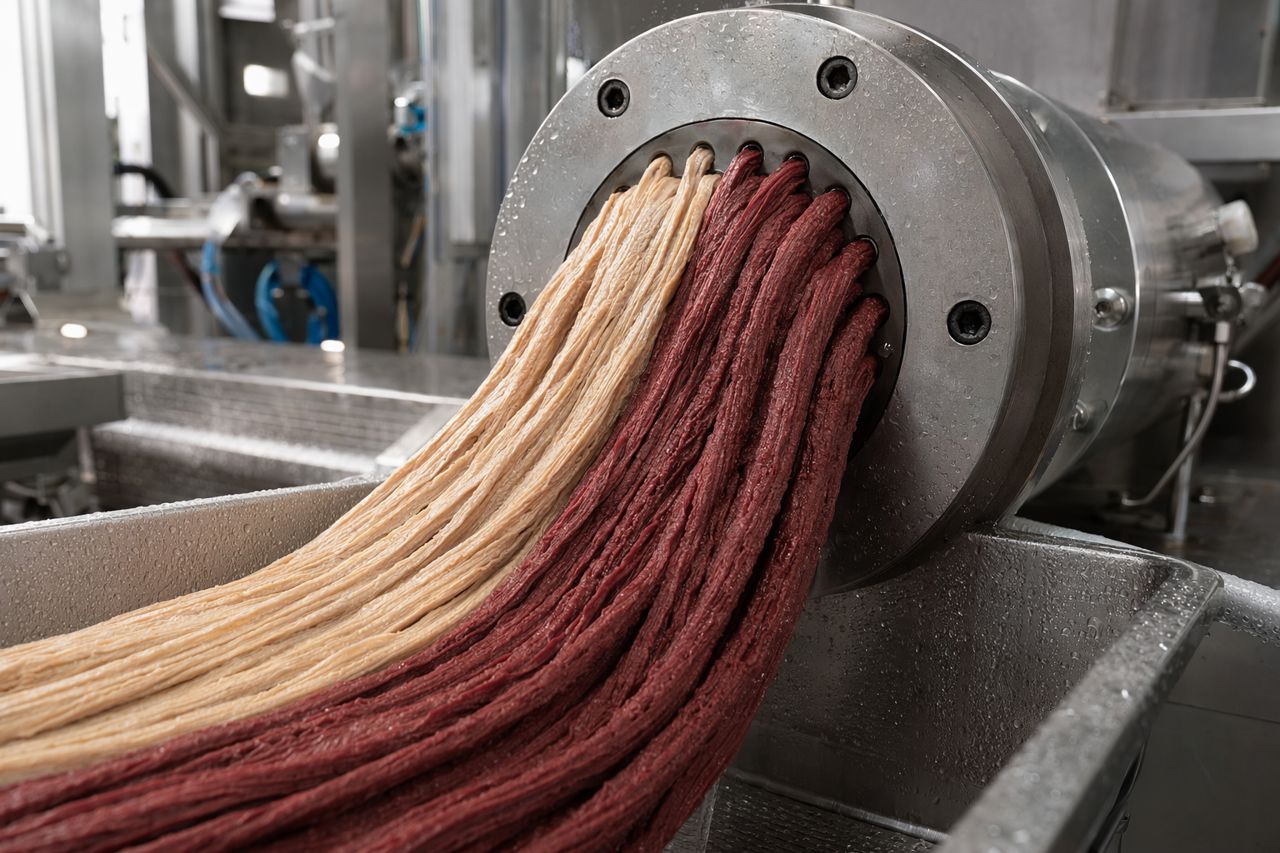
- Process-built texture: high-moisture extrusion, low-moisture texturization, chopping, mixing, filling, and forming all create structure under shear. Freeze-thaw stress challenges that structure after it has already been engineered.
- Multi-phase systems: protein, starch, fibers, gums, oils, flavors, acids, salts, colors, and inclusions compete for water and influence freeze concentration.
The result is not one defect. It is a cluster of defects that appear together.
Typical defects after freezing and thawing
Purge in pack
Visible purge usually indicates poor water immobilization, disrupted gel continuity, or thaw-driven migration through microchannels. It can weaken appearance before the product reaches a pan, griddle, oven, or combi system.
Soft bite and loss of chew
A patty or strip may retain shape but lose resistance. This often points to insufficient protein network connectivity, over-hydration of the continuous phase, or fiber bundles that separate under thaw stress.
Crumbling and edge fracture
Weak particle-to-particle binding becomes obvious after freeze-thaw. Formed products may crack at edges, break during handling, or shed fragments during cooking.
Oil bleed and marbling collapse
Fat systems that looked well dispersed before freezing may coalesce or drain after thawing and heating. This changes mouthfeel, cook yield, surface browning, and visual marbling.
Dryness after cooking
Dry bite can occur even when purge is low. Water may remain in the product but be poorly distributed, or the protein network may contract during cooking and squeeze moisture away from the chew structure.
Texture loss is a system failure, not a single-ingredient failure
Plant-based meat texture is assembled through ingredient selection, hydration order, shear, temperature, residence time, cooling, forming, freezing rate, packaging, and reheat conditions. Enzymes are most effective when they are positioned inside that system rather than added as a late correction.
For example, a crosslinking approach may improve cohesion, but if it is activated too early, the dough can become resistant to forming or extrusion. If it is activated too late, the product may not gain enough freeze-thaw durability. A protein-modifying approach can improve bite or water handling, but the wrong process window can create softness, bitterness risk, or inconsistent cooking response.
The goal is not simply “more binding.” The goal is the right binding architecture for the product format.
Enzyme strategies for freeze-thaw resilience
Enzymefusion works with plant-based meat teams to screen enzyme systems against real manufacturing constraints: protein source, extrusion route, thermal history, fat system, product geometry, packaging format, and intended reheat method.
1. Strengthening protein connectivity
Selected enzyme systems can help build more cohesive protein networks. In formed vegan meat products, this can support slice integrity, bite resistance, and reduced crumbling after thaw.
The practical question is where that connectivity should form: during mixing, after forming, during a thermal set, or inside an extrusion-adjacent process. A useful enzyme strategy should support line behavior, not create dough that is hard to pump, fill, sheet, or portion.
2. Improving water distribution
Freeze-thaw stability depends on water location as much as total water content. Enzyme-enabled protein modification can influence hydration behavior, helping the matrix hold water in a way that supports chew instead of purge.
This is especially relevant in high-moisture analogs, shredded formats, and marbled products where aligned protein domains need to remain distinct but not brittle.
3. Supporting bite without rubberiness
Plant-based meat factories often need firmer bite but cannot accept rubbery compression or a pasty cut face. Enzyme selection should be tuned to texture target: short bite, fibrous tear, sausage snap, burger chew, strip pull, or minced cohesion.
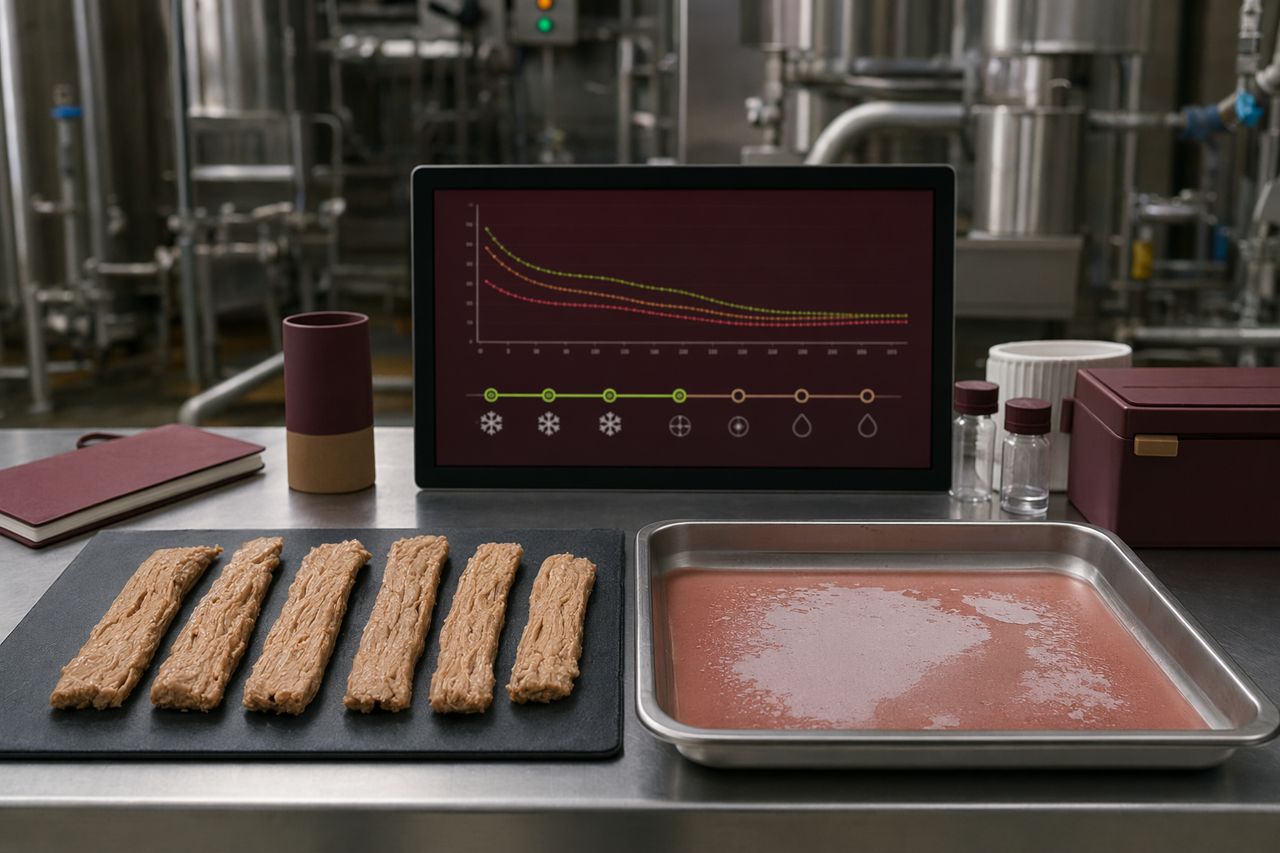
A useful development program compares texture before freezing, after frozen storage, after controlled thaw, and after final cooking. The winning condition is not peak firmness. It is stable eating mechanics across the product journey.
4. Reducing formulation overcorrection
Without a targeted enzyme strategy, teams may compensate for freeze-thaw damage with more gums, starches, fibers, or binders. That can improve handling while making the final bite dense, gummy, or masked.
Enzyme-enabled structure can reduce the need for broad formulation overcorrection by improving the protein network itself. The commercial benefit is cleaner process logic: fewer emergency adjustments, more predictable scale-up, and a product that behaves closer to design intent.
Where process windows matter
Enzymes are process-sensitive tools. In plant-based meat manufacturing, their performance depends on when they contact substrate, how hydration develops, how temperature rises, and when the structure is locked.
Key variables include:
- Hydration sequence and water addition strategy
- Protein pre-treatment and denaturation history
- Salt and pH environment
- Mixing energy and shear profile
- Fat incorporation timing
- Extrusion or forming temperature profile
- Hold time before thermal setting or freezing
- Freezing rate and product geometry
- Thaw method and final cook platform
A factory-ready enzyme solution needs to fit this window. It should not require fragile handling steps that work only in R&D.
Bench tests should reflect commercial abuse
A single fresh-cooked tasting is not enough. Freeze-thaw texture programs should include controlled abuse conditions that resemble the real supply chain.
A practical evaluation plan may include:
- Fresh baseline after manufacture
- Frozen storage hold
- Controlled thaw under refrigerated conditions
- Optional repeat freeze-thaw challenge for high-risk channels
- Cooking on target equipment
- Texture, purge, oil loss, slice integrity, and sensory handling review
For B2B teams, the value is decision clarity. If an enzyme system only improves a fresh sample but fails after thaw, it is not solving the commercial problem.
Product formats that need different answers
Burgers and formed patties
Primary concerns include edge cracking, purge, crumbly bite, and oil release. Enzyme strategy should reinforce particle binding while preserving cook expansion and bite.
Sausages and filled products
These require cohesive gel behavior, casing compatibility, controlled fat dispersion, and resistance to shrink or void formation after thaw.
Strips, chunks, and shredded analogs
The challenge is maintaining aligned tear and layered bite. Over-binding can erase fiber definition; under-binding can create mush or fragmentation.
Nuggets, cutlets, and coated products
Freeze-thaw damage can weaken the core and affect coating adhesion during frying, baking, or reheating. Internal water management is critical.
Marbled and hybrid-structured products
Fat phase stability and visual distribution matter. The enzyme system must support protein architecture without collapsing marbling cues.
What Enzymefusion brings to the development table
Enzymefusion is built for plant-based meat factories that need texture solutions, not generic enzyme catalogs. We help R&D, process engineering, and procurement teams evaluate enzyme systems against measurable manufacturing outcomes:
- Lower purge after thaw
- Better cohesion during forming and cooking
- More stable fibrous bite after frozen storage
- Reduced crumbling during handling
- Improved hot-hold and reheating performance
- Less dependence on broad binder overcorrection
- Process windows that can scale from pilot to production
We work in the language of product format, substrate, shear, thermal set, and line constraints. That makes enzyme selection more precise and implementation faster.
Questions to answer before choosing an enzyme system
Before requesting a recommendation, gather the variables that shape freeze-thaw behavior:
- What protein sources and texturized inputs are in the formula?
- Is the structure created by high-moisture extrusion, low-moisture TVP hydration, chopping, blending, or forming?
- Where does texture fail: after freezing, after thawing, during cooking, or during eating?
- Is the main defect purge, softness, crumble, oil bleed, dryness, or loss of fiber?
- What is the target product format and reheat method?
- Which processing steps are fixed at factory scale?
- Are there clean label, allergen, regional, or certification constraints?
The more precisely the failure is described, the faster the enzyme strategy can be narrowed.
Build freeze-thaw stability into the matrix
Frozen plant-based meat should not be engineered only for the first cook in the lab. It should be engineered for packaging, storage, thawing, handling, heating, and service.
Enzymes can help when they are matched to the protein system and placed in the correct process window. For manufacturers, the payoff is not novelty. It is production-ready texture durability.
Request a quote
If you are developing or reformulating a frozen vegan meat product, Enzymefusion can help evaluate enzyme options for your protein base, process route, and texture target.
Request a quote using the on-site form and include your product format, protein sources, main freeze-thaw defect, and intended processing conditions.