Pea Protein Off-Notes, Texture Tradeoffs and Formulation Decisions
Pea protein is rarely selected because it is easy. It is selected because it is available, functional, familiar to procurement, and capable of building structure when the formulation and process window are controlled. The challenge is that the same properties that make pea protein useful in plant-based meat can make it difficult to finish.
A formulation may gain bite and lose flavor clarity. It may reduce beany aroma and become pasty. It may improve water binding at the bench and then tighten under extrusion, forming, retort, or refrigerated holding. In pea protein systems, off-notes and texture are not separate problems. They are coupled through raw material quality, protein state, moisture management, thermal history, fat design, pH, salt, and shear.
For R&D and operations teams, the question is not whether pea protein can work. The question is how many compromises the system will force before it reaches the target eating profile at factory scale.
Wholesale and bulk supply for manufacturers, co-packers and resellers. Enzymefusion supplies these enzymes by quote only; pack size, volume and delivery are quoted per order. To get a quote, send the product, the quantity and the destination country through the inquiry form.
Why pea protein off-notes intensify during texture work
Pea protein off-notes are often described as beany, earthy, bitter, grassy, dusty, or astringent. Those words are useful in sensory review, but they can hide the formulation mechanics behind the issue.
Off-notes can become more obvious when texture work changes how aroma, fat, water, and protein interact. A tighter network can trap some volatiles while releasing others late in the chew. A drier bite can extend bitterness or astringency. A protein phase with poor hydration can create chalky perception, even when the flavor system is technically strong.
Common triggers include:
- High pea protein inclusion without enough hydration control
- Heat and shear conditions that expose bitter or drying edges
- Flavor masking systems that flatten savory top notes
- Excessive firmness targets that reduce juiciness release
- Raw material lot variation between pilot and production
- Fat systems that separate from the protein phase during cooking or holding
The result is familiar: the product tastes acceptable at the bench, then feels tighter, duller, or more legume-forward after scale-up.
Texture targets create flavor consequences
Plant-based meat factories do not design texture in the abstract. They design against a format, a thermal process, a line speed, and a target bite.
A burger system needs cohesive grind, fat release, browning tolerance, and a chew curve that does not collapse. A minced product needs particle definition and sauce tolerance. A strip or shredded format needs fiber alignment, pull, and resilience after reheating. A formed nugget or cutlet needs binding, coating compatibility, freeze-thaw stability, and controlled moisture release.
Each target puts different pressure on pea protein:
Firmer bite
A firmer system can improve handling and reduce breakage, but it can also expose dryness, bitterness, and a late astringent finish. Firmness without hydration control often reads as tough rather than meaty.
Higher moisture
Higher moisture can improve succulence, but only if the protein phase binds and releases water predictably. If water is loosely held, the product can purge, soften, or lose particle definition.
Stronger fibrous structure
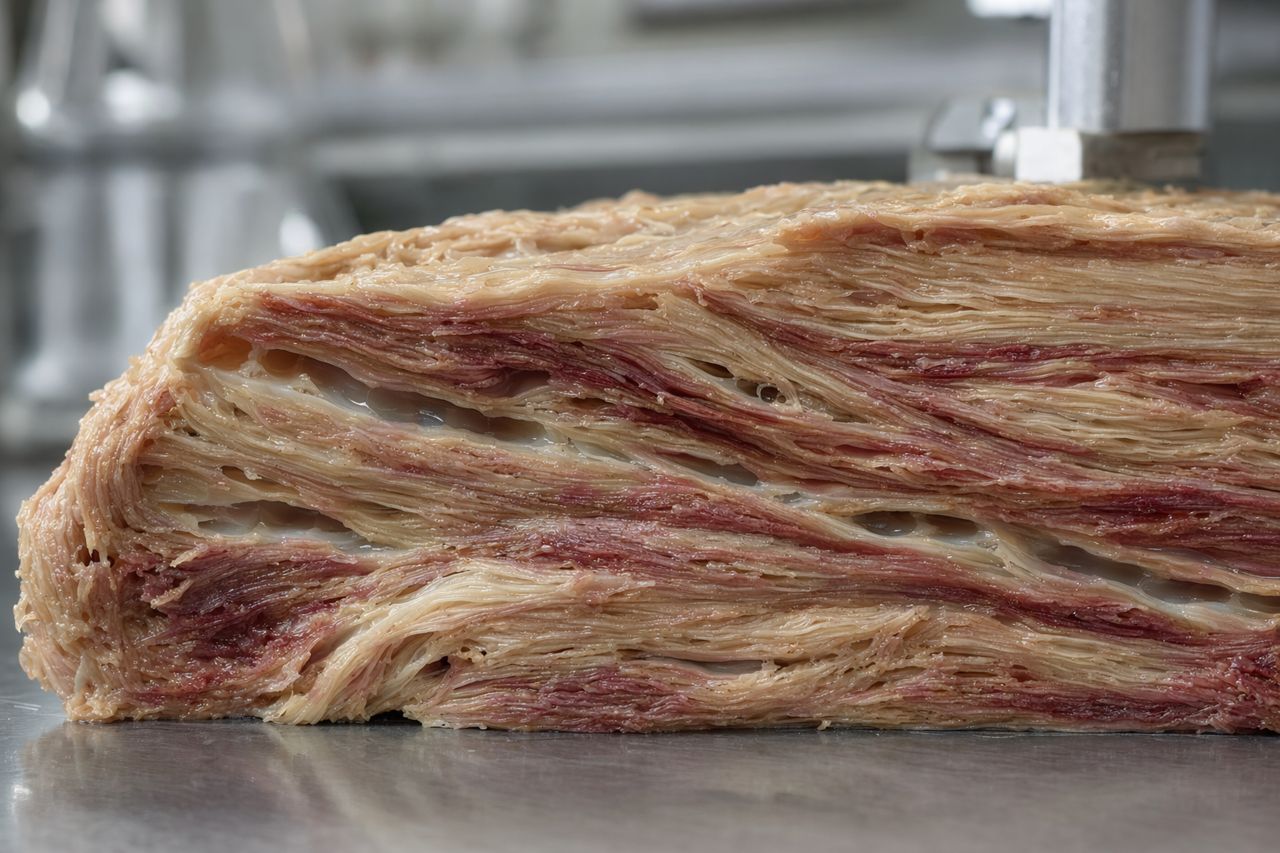
Fibrous structure can improve visual and eating cues, especially in extruded or shear-cell formats. But aggressive alignment can narrow the processing window and make raw material variation more visible.
Cleaner flavor
Cleaner flavor is not simply a masking exercise. Heavy masking can suppress desirable savory, roasted, or fat-derived notes. It can also make the product taste processed rather than engineered.
Where enzyme strategy fits
Enzyme work is most useful when it is treated as a process tool, not a late-stage additive. The goal is to adjust how pea protein behaves before the formulation is locked around its limitations.
Enzymefusion evaluates enzyme pathways around the full manufacturing context: raw protein source, inclusion level, target format, hydration sequence, thermal load, mixing energy, extrusion or forming conditions, and finished product handling. That matters because a useful bench result can fail if it ignores residence time, temperature exposure, shear, salt, fat, or downstream cook steps.
For teams evaluating an enzyme supplier for plant based meat manufacturing, the practical value is not a catalog of ingredients. It is a faster route to decisions that survive pilot trials and production reality.
Enzyme-enabled development can support:
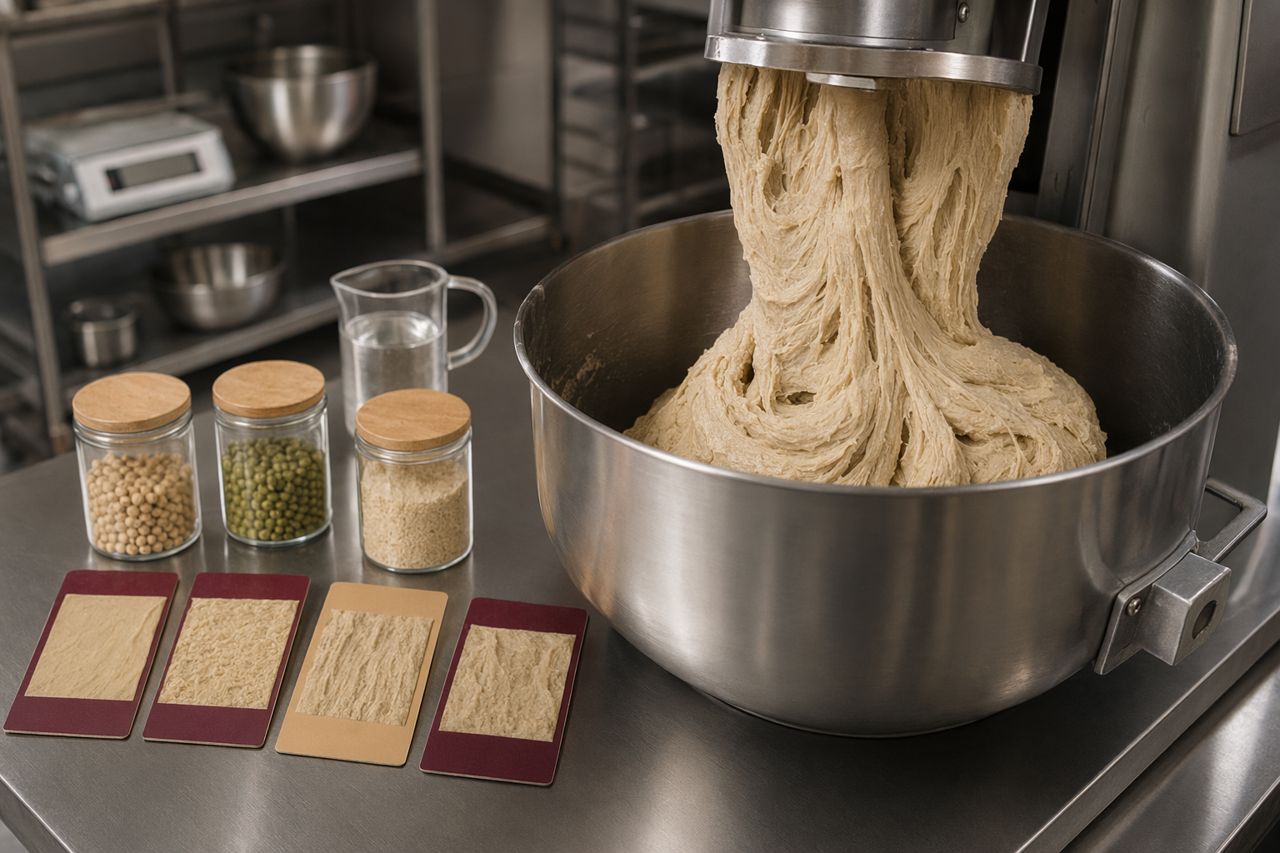
- More controlled protein hydration and dispersion
- Reduced perception of harsh, bitter, or drying edges
- Improved chew without unnecessary toughness
- Better water management through mixing, forming, cooking, and holding
- Cleaner interaction between protein base and savory flavor system
- More predictable performance across raw material lots
- Process recommendations that fit existing equipment constraints
The work is not about making pea protein invisible. It is about making its functional contribution more usable.
What protein processors already do upstream: enzymatic hydrolysis of pea and soy protein
Plant-drink makers met the pea off-note problem before meat-analogue lines did, and their fix is enzymatic hydrolysis of the protein before it goes into the product. They treat pea protein with alkaline protease, neutral protease, papain or bromelain, sometimes with cellulase, and break it down into small functional peptides and amino acids, which raises solubility sharply. After that treatment the raw beany, fishy note of the protein weakens, flavour improves and emulsification gets better, while the original pea aroma can be kept. The enzymes do not do the same job: cellulase-treated pea protein foams better, neutral protease is the choice for solubility and emulsifying behaviour, and the enzyme dose moves the degree of hydrolysis and with it the water behaviour of the protein. Processors also report a production side effect: once most of the protein, fat and fibre is hydrolysed, filtration runs better, throughput rises and less waste solid leaves the line.
Soy shows a second failure that buyers of concentrate should know about: concentrate made by alcohol washing has its protein changed by the extraction, loses water solubility, and then gives low yield and slow, inefficient hydrolysis. The working fix is a carbonate soak or wash first to bring solubility back, then a protease such as papain, alkaline protease, a soy protein hydrolase or a flavour enzyme, with temperature, pH, substrate concentration, enzyme dose and reaction time all tuned for the batch.
The trade-off for a meat analogue
| Goal | What hydrolysis does | What it costs a meat analogue |
|---|---|---|
| Cleaner flavour | weakens the beany, fishy note | shorter peptides carry less structure |
| Solubility and dispersion | raises solubility sharply | a softer, pastier bite if taken too far |
| Emulsified fat | improves emulsifying behaviour | needs a binder or crosslinker to hold shape |
| Process yield | better filtration, less waste solid | only matters where the protein is filtered or separated |
A drink wants the protein fully dissolved; a burger, mince or strip still needs long protein chains to build bite. So ask a supplier how far to hydrolyse, and what then rebuilds the network.
Where buyers go wrong
- Treating every protease as the same. The processors above pick neutral protease for solubility and emulsifying and cellulase for foaming; a single "protease" line in a quote says nothing about which job it does.
- Blaming the enzyme for a bad concentrate. An alcohol-washed soy concentrate with lost solubility hydrolyses poorly whatever enzyme is used, until it is pre-treated.
- Copying a fixed recipe. Temperature, pH, substrate concentration, dose and time all have to be set for your own protein and batch.
Request a quote: send your protein base, how it was made, the format, volume and destination through the inquiry form; we reply by email.
The central tradeoff: structure versus sensory drag
Most pea protein projects reach a point where the team can solve one problem by worsening another.
Add structure, and the product becomes dry. Add fat, and the system loses definition. Increase flavor load, and savory notes become heavy. Increase moisture, and the bite softens. Change the protein grade, and procurement or labeling constraints re-enter the conversation.
This is the tradeoff zone where enzyme screening can create useful formulation space. By shifting protein behavior, even modestly, the system may need less compensation elsewhere. That can mean less masking, less overbuilding of texture, fewer corrective binders, or a more forgiving hydration sequence.
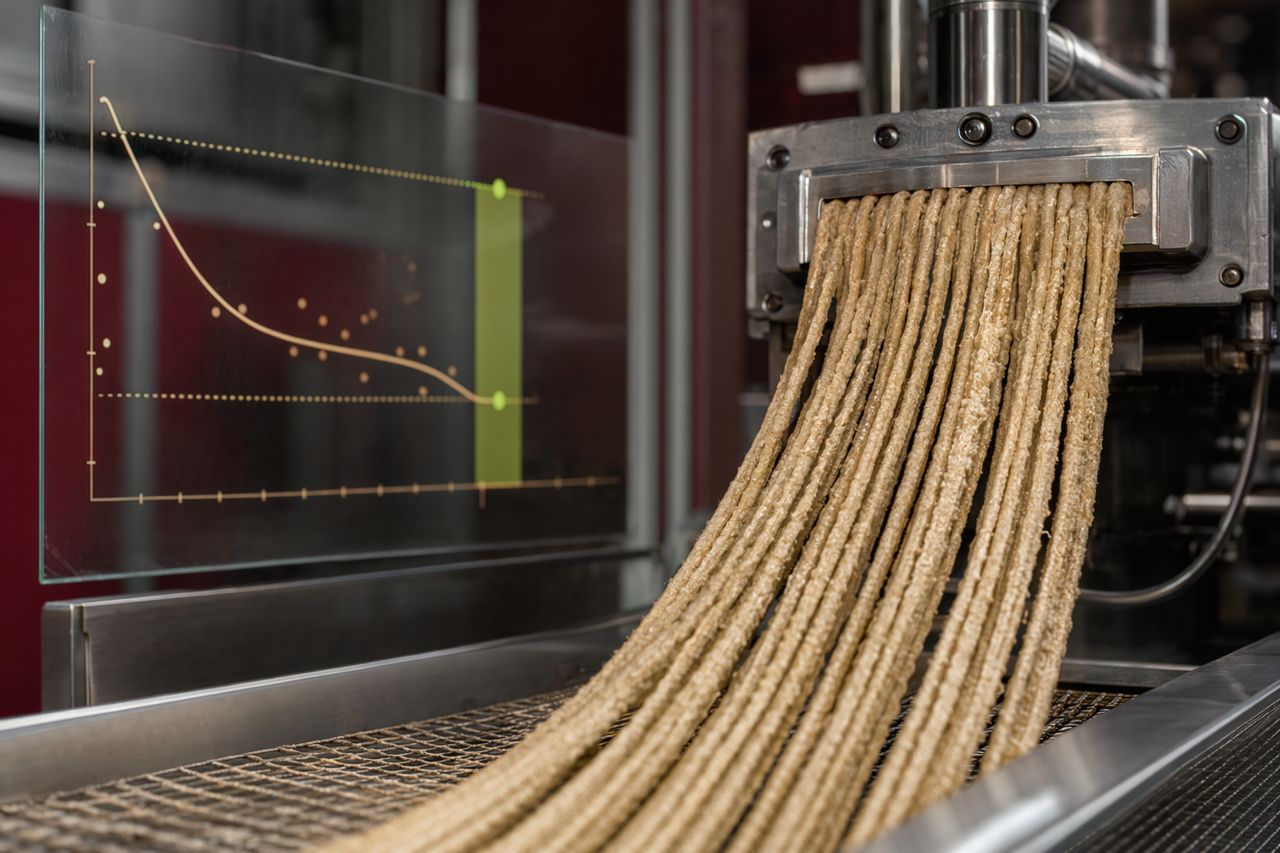
The right enzyme direction depends on the product architecture. A high-moisture extruded strip, a low-moisture textured protein rehydration system, and a formed burger matrix will not need the same intervention. They may share pea protein, but they do not share the same failure mode.
What to diagnose before changing the flavor system
Before adding another masking layer, it is worth asking whether the flavor issue is being amplified by texture mechanics.
1. When does the off-note appear?
Early aroma, mid-chew bitterness, late astringency, and aftertaste point to different formulation pressures. A beany top note may need a different approach than a drying finish.
2. Is the bite dry or actually low in moisture?
A product can contain enough water and still eat dry if water is poorly distributed or released at the wrong time. Sensory dryness is often a structure problem, not a simple moisture problem.
3. Does scale-up increase the defect?
If the defect grows from bench to pilot, process conditions are likely part of the cause. Mixing order, hydration time, heat input, shear, and hold conditions should be reviewed before the formula is judged.
4. Is the protein lot stable enough?
Pea protein variability can shift hydration, viscosity, color, aroma, and extrusion behavior. Enzyme recommendations should be tested against realistic raw material variation, not a single clean sample.
5. Are masking and texture working against each other?
Some masking strategies can thicken the base, mute savory release, or create a lingering sweetness or roast note. If texture and flavor are tuned separately, the final product can feel assembled rather than integrated.
A practical decision map for R&D teams
A useful pea protein program should move through decisions in a controlled order:
- Define the target bite in manufacturing language: firmness, chew length, fiber definition, juiciness release, sliceability, crumble behavior, or coating tolerance.
- Identify the dominant sensory defect: beany aroma, bitterness, earthy base note, chalkiness, dryness, or astringent finish.
- Map the process window: hydration sequence, mixing energy, temperature exposure, shear, residence time, forming pressure, cook step, cooling, and storage.
- Screen enzyme directions against the actual process, not only the ingredient in isolation.
- Evaluate flavor after texture changes, because the perceived flavor balance may shift once the protein phase behaves differently.
- Confirm performance under pilot conditions and with representative raw material lots.
This sequence prevents a common failure: optimizing a beautiful bench sample that has no path through the factory.
What Enzymefusion brings to the formulation table
Enzymefusion works with plant-based meat manufacturers that need enzyme strategy tied to product architecture and line conditions. We focus on the decision points that matter to R&D, pilot teams, procurement, and manufacturing:
- Which pea protein constraint is actually limiting the product?
- Where can enzyme processing widen the usable formulation window?
- What changes are realistic within the existing process?
- How will the recommendation behave under heat, shear, salt, fat, and hold time?
- What should be tested first to avoid unnecessary bench cycles?
The deliverable is not just a sample. It is a technical direction built around your target format, your process, and your commercial constraints.
When to engage an enzyme partner
Bring enzyme work into the project before the formulation becomes overloaded with fixes. The best timing is when the team has a defined product target but has not yet locked every binder, flavor, and process assumption.
Useful entry points include:
- Pea protein inclusion is increasing and off-notes are becoming more exposed
- Texture is acceptable, but the bite is dry or lingering
- Flavor masking is making the profile dull or heavy
- Pilot scale is creating firmer, darker, or more bitter results than the bench
- Raw material variation is forcing repeated adjustments
- The team needs a cleaner path from prototype to factory trial
Pea protein can carry structure, but it should not dictate every compromise in the formula.
Request a quote
If pea protein is forcing a tradeoff between cleaner flavor and controlled texture, Enzymefusion can help evaluate the enzyme route and supply it in bulk, by quote only. Pack size, volume and delivery are quoted per order.
Send the enzyme or the problem, the quantity, the destination country, and your format, protein base and process conditions through the inquiry form. We reply by email.