High-Moisture Extrusion Texture Variables That Matter Before Enzyme Trials
Enzymes can be a precise lever for plant-protein texture, but they are rarely the first variable to fix. In high-moisture extrusion, the material already carries a complex process history before any enzyme decision has a fair chance to show value.
For manufacturers, co-packers and the ingredient distributors who supply them, the goal is not to “add an enzyme” and hope for bite. The goal is to define the texture target, stabilize the extrusion window, and then use enzyme chemistry where it can improve structure, hydration behavior, binding, or post-extrusion consistency.
That is the practical difference between a supplier conversation and a development partnership. A capable enzyme supplier for plant based meat manufacturing should ask about your protein system, thermal profile, shear history, cooling die behavior, and finished texture metrics before recommending a trial path or quoting a volume.
Wholesale and bulk supply for manufacturers, co-packers and resellers. Enzymefusion supplies these enzymes by quote only; pack size, volume and delivery are quoted per order. To get a quote, send the product, the quantity and the destination country through the inquiry form.
Start With The Texture Target, Not The Ingredient List
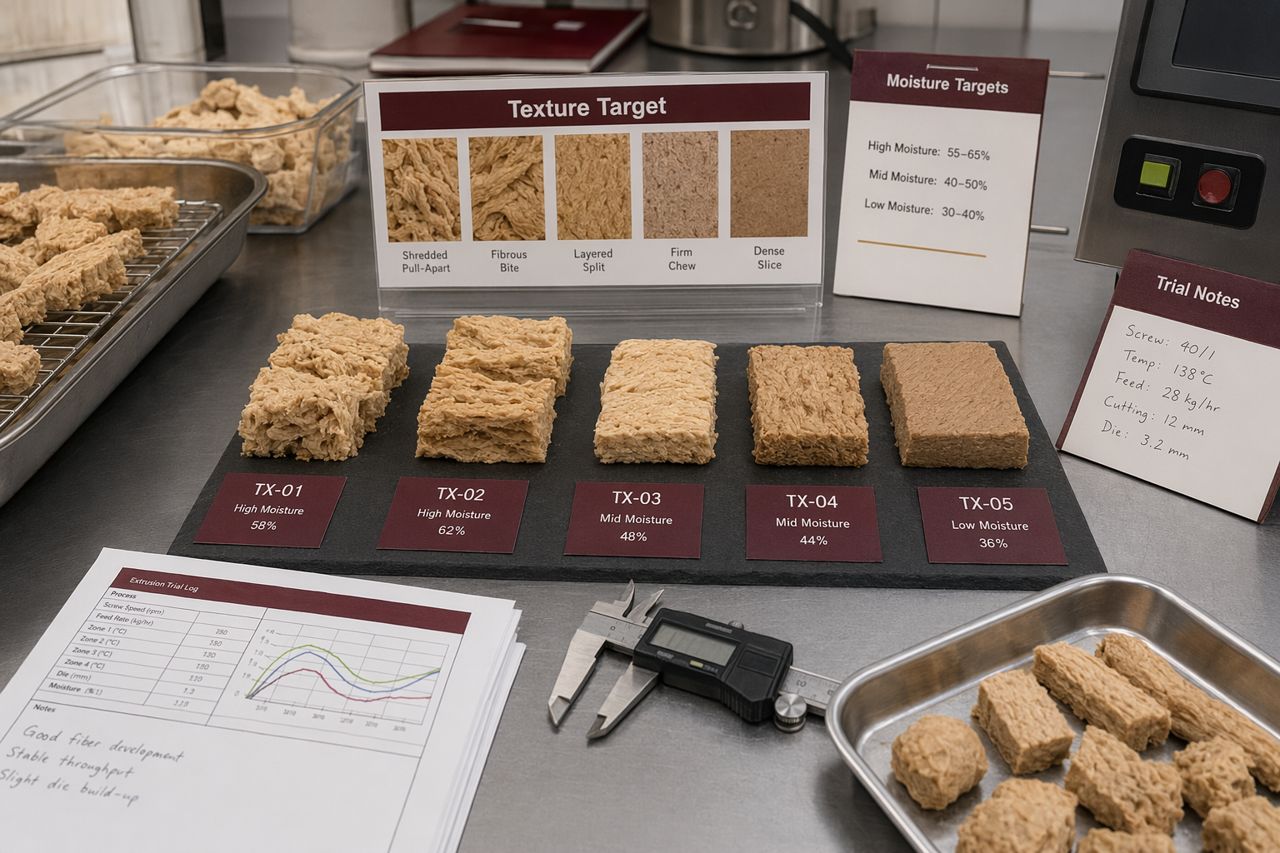
Before screening enzymes, define what “better texture” means in your system. High-moisture extrusion can produce very different outcomes depending on the intended product format.
You may be targeting:
- Long, aligned fibers for pulled or shredded formats
- Shorter, layered bite for strips or chunks
- Cohesive firmness for formed pieces
- Lower rubberiness without losing chew
- Improved juiciness retention after cooling and reheating
- More consistent strand definition across production runs
These targets require different process windows. An enzyme strategy that supports one structure may weaken another if the baseline texture is not clearly defined.
Protein Source And Fraction Quality Set The Ceiling
Pea, soy, wheat, fava, chickpea, canola, and blended protein systems do not behave interchangeably in high-moisture extrusion. Even within one protein source, lot-to-lot variation can change hydration rate, viscosity development, melt behavior, and final fiber alignment.
Before enzyme trials, document:
- Protein source and supplier
- Protein concentration and ash contribution
- Particle size profile
- Solubility behavior in the process water system
- Heat history of the protein ingredient
- Presence of starch, fiber, gums, or residual oil
- Lot variation across pilot and production material
If the base protein does not form a stable melt or strand network under shear, enzyme treatment may only amplify inconsistency. The enzyme brief should be built around the actual substrate, not a generic plant-protein category.
Moisture Is A Structure Variable, Not Just A Formula Line
High-moisture extrusion depends on water as a plasticizer, heat-transfer medium, and mobility control. Small changes in moisture distribution can shift the product from fibrous and aligned to pasty, swollen, or brittle.
Before enzyme screening, verify how water enters and moves through the system:
- Pre-hydration time and mixing energy
- Water temperature at addition
- Dry blend order
- Liquid addition point
- Hold time before extrusion
- Water binding from fibers, starches, and hydrocolloids
- Moisture loss between die exit, cooling, cutting, and packing
Enzymes can influence hydration behavior, but they cannot fully compensate for uneven water distribution or unstable preconditioning.
Thermal History Controls What The Enzyme Actually Sees
In high-moisture extrusion, proteins experience heat, pressure, shear, and rapid structural change. The relevant question is not only the barrel temperature setpoint. It is the real thermal exposure of the material as it moves through the system.
Map the process around:
- Feed zone behavior
- Mixing and kneading sections
- Melt formation
- Peak thermal exposure
- Residence time distribution
- Cooling die temperature gradient
- Product temperature at exit
- Post-extrusion hold and chill rate
Some enzyme strategies are designed for pre-extrusion modification. Others may be better positioned around post-extrusion binding or texture stabilization. The right choice depends on where the enzyme can act without being neutralized too early or carried into a process zone where it no longer supports the intended structure.
Shear And Specific Mechanical Energy Shape Fiber Formation
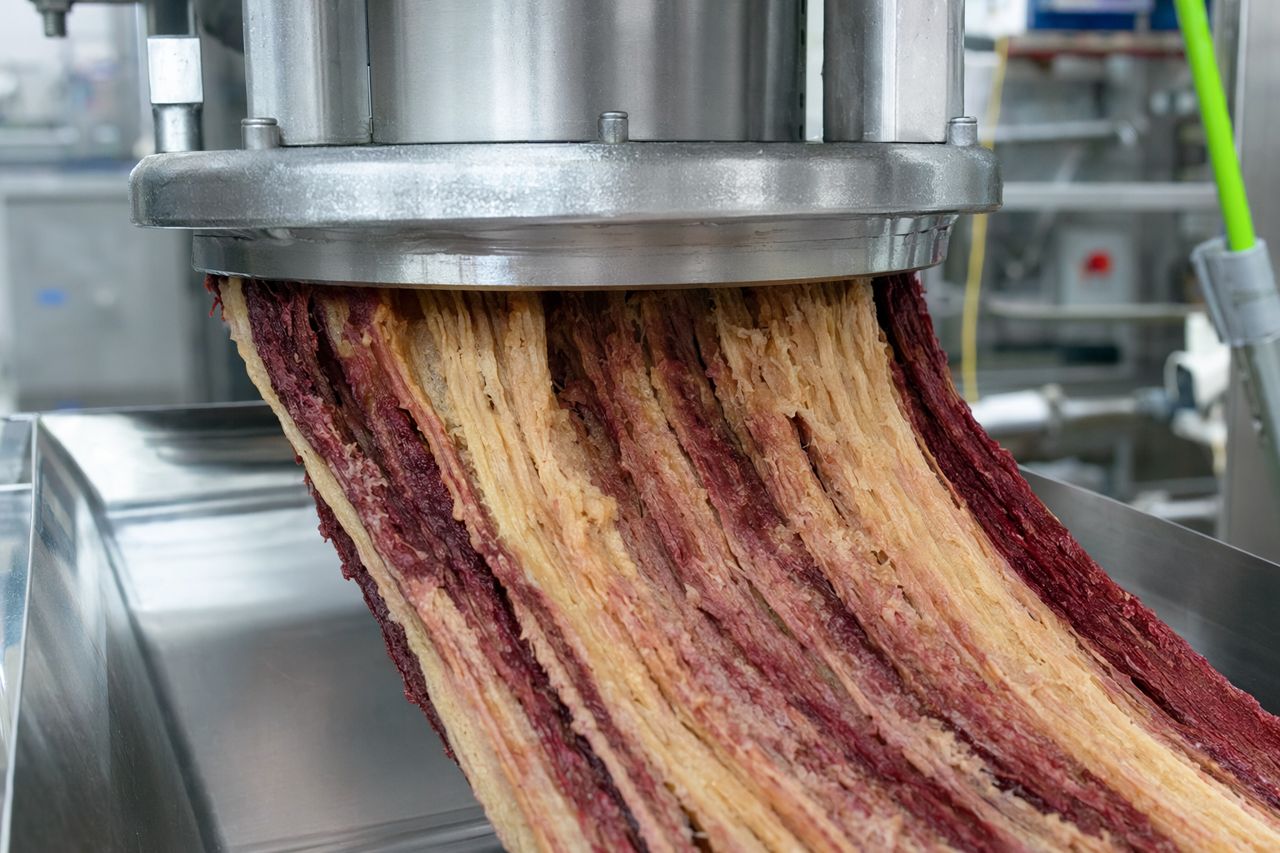
Fiber alignment depends on the interaction between melt viscosity, shear, pressure, and cooling. Screw design, speed, feed rate, and die geometry all influence whether proteins stretch into oriented structures or collapse into a dense, uniform mass.
Key variables to capture include:
- Screw configuration and element sequence
- Feed rate stability
- Screw speed
- Torque trend
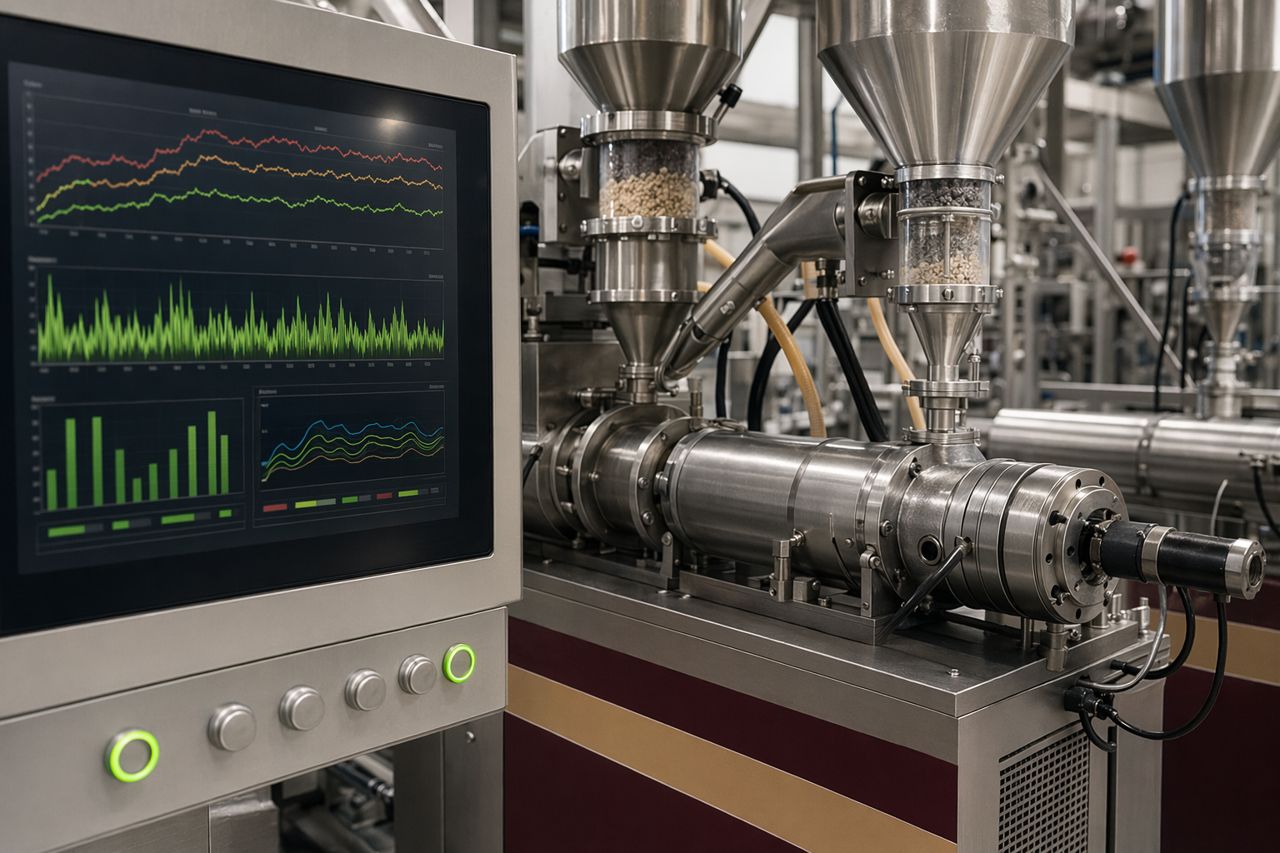
- Pressure trend before the die
- Cooling die length and geometry
- Cut point and mechanical handling after exit
If shear conditions are underdeveloped, the product may lack strand formation. If shear is too aggressive, the structure may become smeared, tough, or fragile. Enzyme trials should be evaluated against this mechanical baseline, not judged in isolation.
Salt, pH, And Minor Ingredients Can Redirect The Network
Plant-protein systems are sensitive to ionic strength, pH, emulsification state, and the order in which minor ingredients are introduced. These details affect protein unfolding, water distribution, oil dispersion, and the final texture map.
Before introducing enzyme variables, review:
- Salt level and timing of addition
- Acid or alkali adjustments
- Buffering from protein ingredients
- Oil type and addition point
- Emulsifier system
- Starch gelatinization contribution
- Fiber and hydrocolloid interactions
- Flavor system compatibility with process heat
A formulation that performs at bench scale may shift dramatically once it enters a high-shear, high-moisture extruder. The enzyme plan should account for those interactions early, especially when the target is repeatable production texture.
Oil Phase Placement Changes Bite And Marbling
Oil is not only a fat line in the formula. It changes lubrication, melt behavior, visual marbling, and perceived juiciness. In some systems, oil added too early can interrupt protein-protein interactions. In others, delayed addition creates better phase separation but raises dispersion challenges.
For enzyme trial planning, define:
- Oil type and melting profile
- Addition point and temperature
- Emulsion versus direct addition
- Interaction with flavor carriers
- Distribution in the final extrudate
- Impact on slicing, shredding, or forming
If the desired product includes visible marbling or layered fat pockets, enzyme and process decisions must protect that architecture rather than homogenize it away.
Measure Texture In The Same Form The Customer Buys
Extrudate texture can look successful at the die and fail after chilling, cutting, freezing, thawing, cooking, or hot holding. Before enzyme screening, align test conditions with commercial handling.
Useful evaluation points include:
- Strand definition after cooling
- Cohesion during cutting or shredding
- Bite firmness after reheating
- Juiciness retention after cook loss
- Resistance to crumbling in further processing
- Texture drift after storage
- Batch-to-batch variation at the same operating window
A pilot sample pulled warm from the line is not the same material your customer experiences. Enzyme trials should be judged through the full process chain.
What To Bring Into An Enzyme Trial Brief
A strong technical brief shortens the path from screening to scale-up. It helps your enzyme partner identify realistic mechanisms and avoid trial designs that only create noise.
Bring:
- Target product format and desired texture attributes
- Current protein system and supplier details
- Formula ranges rather than a single locked formula, when possible
- Extruder type and screw configuration summary
- Moisture range and liquid addition method
- Thermal profile and cooling die conditions
- Known failure modes: mushy, rubbery, brittle, smeared, crumbly, dry, or inconsistent
- Commercial constraints, including labeling, processing sequence, and hold times
- How success will be evaluated at pilot and production scale
This level of detail turns an enzyme conversation into a controlled development program.
Where Enzymes Can Add Value After The Baseline Is Stable
Once the extrusion variables are understood, enzyme work can become more targeted. Depending on the protein system and product design, enzyme solutions may support:
- Modified protein interactions before extrusion
- Improved hydration and mixing behavior
- Texture refinement without major formula rebuilds
- Better cohesion in downstream forming
- Reduced crumbliness after slicing or shredding
- More consistent bite across process variation
- Support for scale-up from pilot to production equipment
The strongest results usually come when enzyme selection is paired with process data, not treated as a last-minute correction.
The Scale-Up Reality
Bench hydration studies and small pilot trials can be useful, but high-moisture extrusion is equipment-sensitive. A texture that appears promising on one system may change when screw diameter, die length, feed dynamics, cooling capacity, or downstream handling changes.
For scale-up, plan for controlled iteration:
- Lock a baseline formula and process window.
- Define two or three texture failure modes to solve.
- Run enzyme candidates against the same process baseline.
- Evaluate finished product after the intended commercial handling cycle.
- Adjust process and formulation only after the enzyme signal is clear.
This prevents the trial from becoming a moving target.
Request A Quote For Enzyme Supply To An Extrusion Line
Enzymefusion supplies enzymes in bulk to plant-based meat manufacturers, co-packers and ingredient resellers, by quote only. Pack size, volume and delivery are quoted per order, together with enzyme selection and trial planning for texture-driven applications.
To get a quote, send through the inquiry form: the enzyme or the texture problem, the quantity (trial lot or production volume), the destination country and, if you have them, your protein system, product format and extrusion stage. We reply by email.