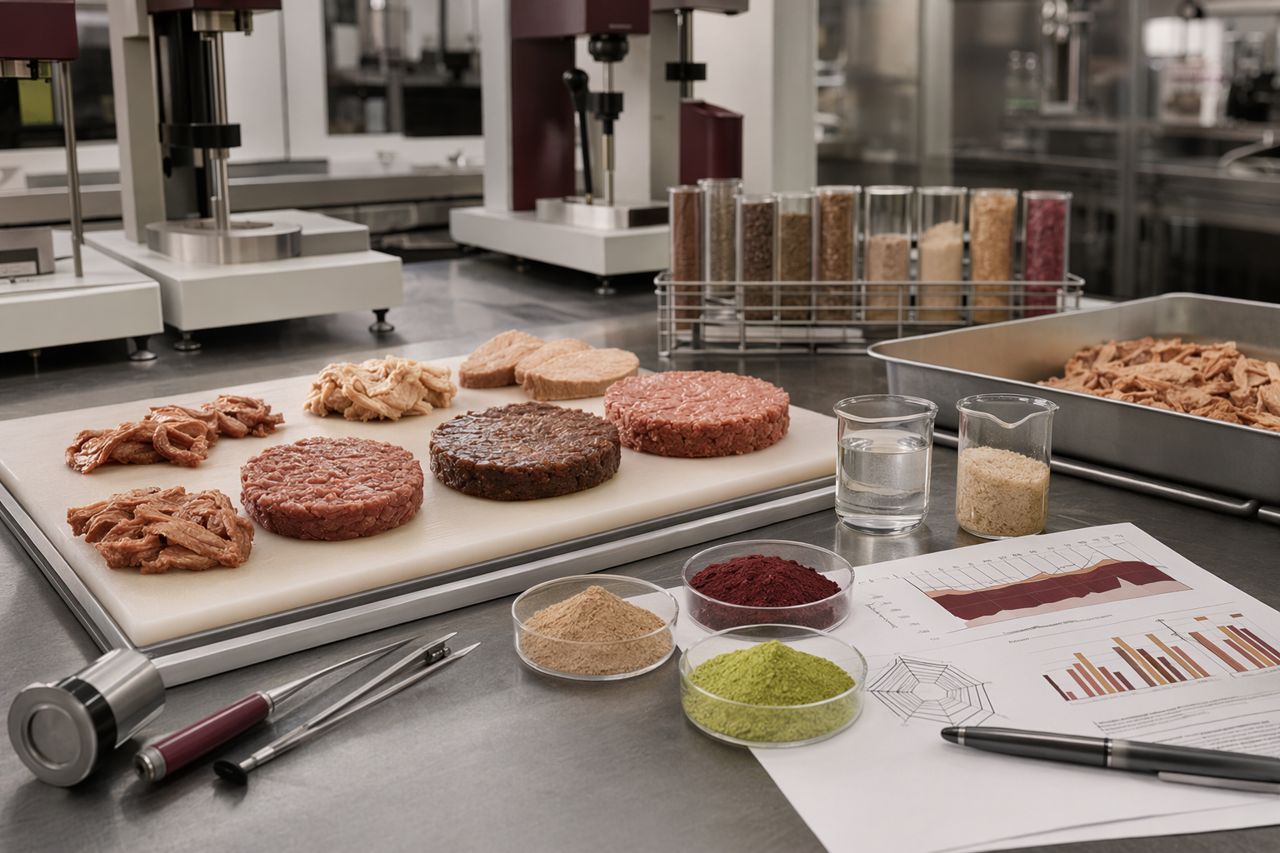
Clean label in a plant-based burger, mince or nugget line comes down to one question: what holds the patty together once methylcellulose leaves the ingredient deck. The most-watched home test of methylcellulose substitutes admits in its own description that nothing replaces it entirely so far, and the sharpest comment under it calls methylcellulose "still the clear winner". So the swap is a system change, not an ingredient change; this page compares the binder routes, gives the numbers that exist, says where they do not, and ends with what to ask a supplier.
Wholesale and bulk supply for manufacturers, co-packers and resellers. Enzymefusion supplies these enzymes by quote only; pack size, volume and delivery are quoted per order. To get a quote, send the product, the quantity and the destination country through the inquiry form.
Why methylcellulose is so hard to replace
Methylcellulose gels when heated and relaxes when cold, the opposite of most plant proteins and starches, and that hot-set is what gives a patty bite in the pan and shape on the grill. The video that made the ingredient famous among home formulators presents it as the one missing ingredient behind the bite, snap and chew of the leading commercial burgers. Viewers who followed the recipe report that the result moved more with the protein base than with the binder: one calls the TVP brand used "the mushiest already", another rehydrates TVP in beef-style broth instead of plain water for flavour. A weak base makes every binder look bad.
Transglutaminase: the binder that works inside the protein
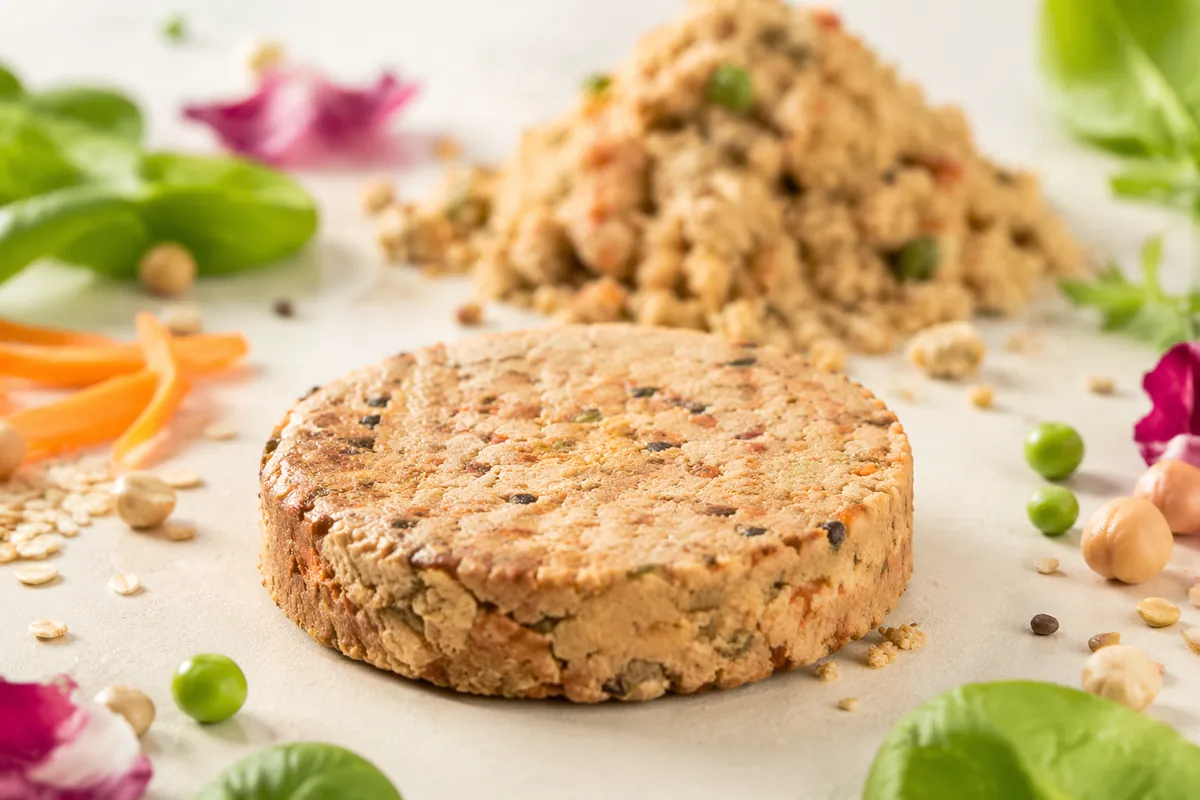
Transglutaminase (TG) catalyses a covalent bond between glutamine and lysine side chains on neighbouring protein molecules, a bond that does not break again under ordinary non-enzymatic conditions, so it tightens the protein network itself instead of wrapping a gel around it. The same enzyme is already sold specifically for imitation vegetarian products, the layered tofu format, and comes in single-kilogram packs. Its two other established jobs are springiness in meatballs and fish balls, and re-binding ham and sausage pieces, so the dosing logic a meat plant already uses carries over to plant formats.
Grades are sold in a narrow activity band: the printed specifications read 80-120 U/g on one pack and 100-120 U/g on another, with a 12-month shelf life, and the maker states that several TG models exist for different applications. Those are hundreds of units per gram, not hundreds of thousands: a plant-protein hydrolysis protease on the market is specified at 300,000-400,000 U/g, so activity numbers are never comparable across enzyme types, only between TG grades.
No source we trust gives a TG dose for pea, soy or wheat protein in a meat analogue, and we will not print one. The 3D-printed analogue study that used TG delayed its crosslinking by temperature control but did not report the enzyme dose, pH or holding time. Instead, ask the supplier for a dose range per kilogram of mix for your protein base with the U/g it was set for, then run a three-dose ladder with and without a chilled rest and score cook loss, purge and a cut test.
The gel route: the only numbers on record
The best numbers we have for a methylcellulose-free binder come from a dual-crosslinked gelatin-alginate hydrogel used as a 3D-printing ink for meat analogue, with the TG crosslink delayed by temperature so the ink could be shaped first. Water holding reached 100%, against under 30% for alginate alone; freeze-thaw loss fell to 2.83% from 20.57%, and cooking loss to 7.27% from 15.17%, at gelatin levels of 2.5%-10%. The authors describe a "uniform honeycomb structure, enhanced hardness and chewiness". Two cautions before anyone copies it: gelatin is animal-derived, so this exact system does not fit a vegan label, and the figures come from a printed gel, not a formed patty on a forming line.
Protease upstream: fix the base, not the binder
Protease does not bind; it repairs the protein you bind with. Hydrolysing pea protein with blends of alkaline and neutral protease, cellulase, papain or bromelain is reported to stop layering, cut fishy and other off-flavours, and give a smoother mouthfeel and better emulsification in plant-protein drinks. For soy, papain with alkaline protease works, but pH, temperature, substrate concentration, dose and time all need optimising, and alcohol-washed soy concentrate loses solubility, which a carbonate wash pre-treatment helps restore. In a meat analogue the risk is over-hydrolysis: a protein cut too far has no network left for TG or anything else to bind, so protease belongs upstream, on the protein ingredient, and only lightly.
Under a video on pea protein taste, commenters describe it as raw flour stirred into water and as "literal swamp powder", and every fix they offer is masking with cocoa, cinnamon, banana or stevia. A shorter label cannot carry masking, so treat the protein upstream and let the binder bind.
Binder options compared
| Binder route | What it fixes | What it costs you | Dosing basis | Where it fails |
|---|---|---|---|---|
| Methylcellulose | Hot-set bite, shape on the grill, forgiving of water level | A label line most briefs now want gone, cost pressure in some markets, and no one-for-one replacement so far | By weight of mix, with its own water level | When the label must lose it; alternatives tested at the same water level come out worse |
| Transglutaminase (TG) | Covalent protein-protein bonds, cohesion through freezing and cooking, re-binding of pieces | Needs reactive protein, a hold step and timing; dose is set by trial, not by a sheet | Per kilogram of mix against the grade's activity, 80-120 U/g class | Crosslinked too early, before shaping; rest step written as chilled in one place and frozen in another |
| Gel binder (gelatin-alginate, TG dual crosslink) | Water holding 100%, freeze-thaw loss 2.83%, cooking loss 7.27% | Gelatin is animal-derived; data come from printed gels | Gelatin 2.5%-10% | Alginate alone: under 30% water holding, 20.57% freeze-thaw loss |
| Protease-modified protein (upstream) | Solubility, off-notes, emulsification of the pea or soy base | No binding on its own; over-hydrolysis destroys the network | Activity class 300,000-400,000 U/g; pH, temperature, dose and time optimised per protein | Alcohol-washed soy concentrate with poor solubility; over-cut pea protein |
| Whole-food binders (cooked chickpea flour, dried beans, flax, potato flake) | Short label with familiar names | Raw-plant flavour unless well cooked; water level must be re-tuned per binder; mushy if the base is wet | By recipe and trial | Under-cooked chickpea flour tastes raw; same water for every binder; wet beans turn to mush |
Where the extrusion line ends and the binder begins
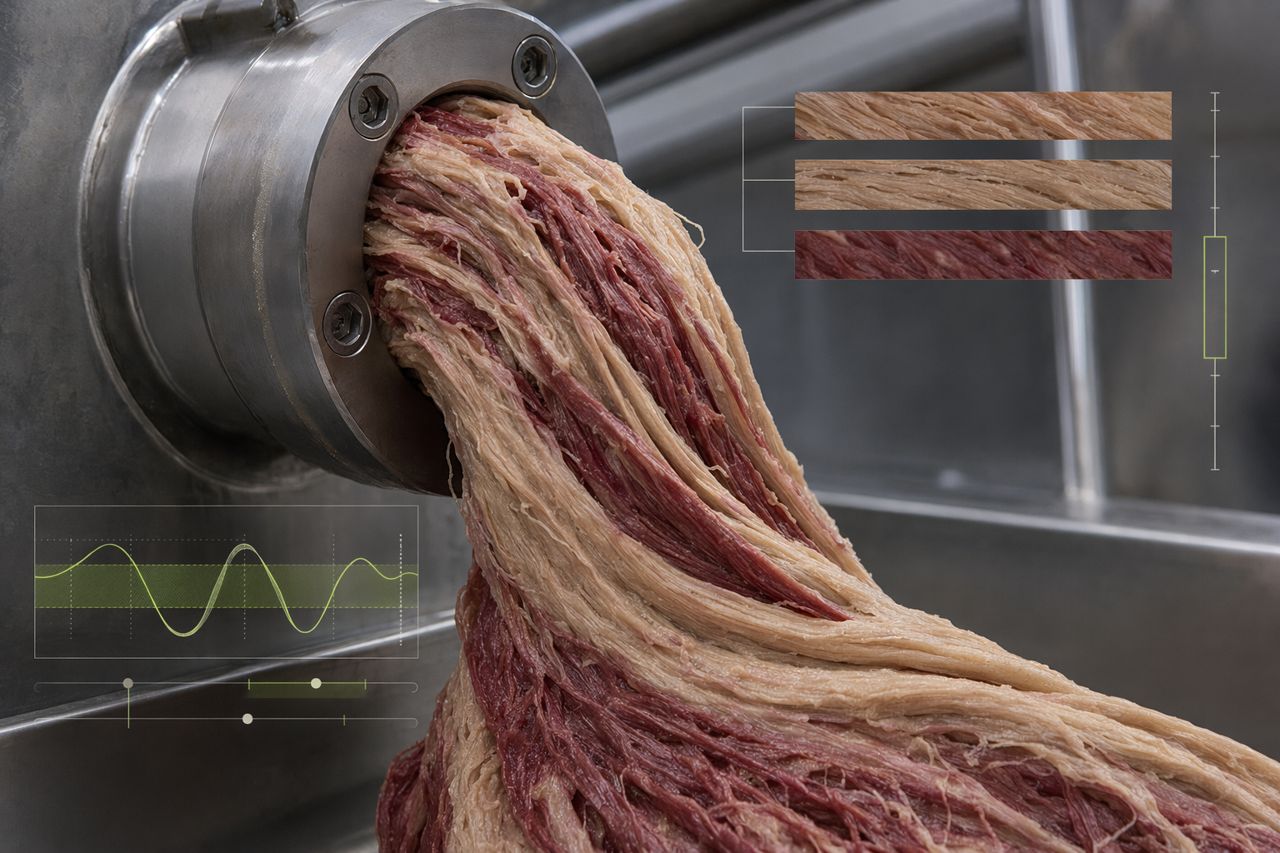
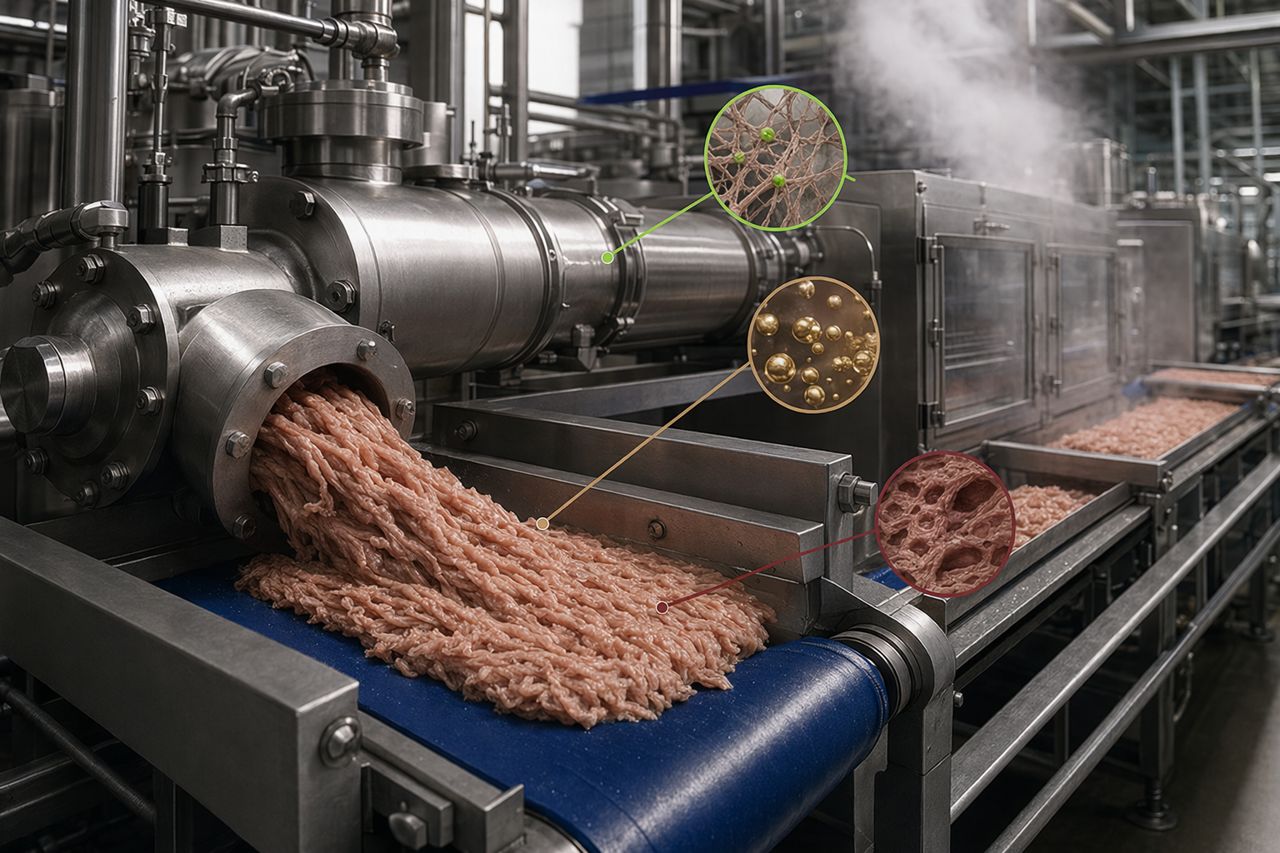
High-moisture extrusion on a twin-screw extruder with a cooling die turns soy, lupine or pea into a strand whose texture comes close to meat, and that is where fibrous tear is decided. A lab run on an 11 mm twin-screw with a cooled slit die draws the same two questions in its comments: whether 140 C costs protein, and why some lines promise beef texture while others only promise chicken or fish. The binder's job starts after the die, holding extrudate, fat and water together through freezing and cooking.
Failure cases we see when methylcellulose comes out
- Crosslinking before shaping. The analogue study's whole trick was holding TG back by temperature until the ink was shaped; let TG run in the mixer and you get a set mass that will not fill a mould cleanly.
- An unclear rest step. Under a TG demonstration, viewers ask whether the bonded block goes in the fridge for 4-24 hours or into the freezer, and whether it can be cooked with the enzyme still on; put the hold temperature and time on the batch sheet.
- Buying by the name TG without an activity figure. Packs sold for vegetarian binding often state no activity at all, and a dose per kilogram means nothing without the U/g it was set for.
- Comparing U/g across enzymes. A 300,000-400,000 U/g protease is not a stronger product than a 100-120 U/g transglutaminase; they measure different reactions on different substrates.
- An over-hydrolysed base. Protease conditions that suit a drink, where solubility is the goal, cut a meat-analogue protein too far; dose, time, pH and temperature are set per protein and per purpose.
- Masking off-notes instead of treating the protein. Cocoa, cinnamon and sweetener are what consumers reach for, and none of them fit a savoury patty or a short label.
- The same water for every binder. The substitute test used one water level for all candidates, and a commenter points out that the level that suits methylcellulose is too much for the others; re-tune hydration per binder.
- Consumer fear of "meat glue". Under a meat-reconstruction clip, comments call TG dangerous and accuse restaurants of passing scraps off as steak; prepare plain-language answers for the retailer questionnaire before launch.
What to ask a supplier before a TG trial
- Which model. The maker states that several TG models exist for different applications; ask which one is meant for plant protein rather than for meat re-binding.
- Activity and assay. Ask for the U/g and the assay behind it, so two grades can be compared; 80-120 U/g and 100-120 U/g are the printed bands we have seen.
- A starting dose per kilogram of mix for your protein base, with its hold temperature and time; a dose not tied to a named base is a guess.
- Proof on bind-and-spring jobs. A grade also used for meatball and fish-ball springiness and for ham and sausage re-binding has a track record on cohesion under chilling and cooking.
- Shelf life and storage. The printed spec is 12 months; ask how it was stored before shipping.
- Trial pack size. Single-kilogram packs exist for the vegetarian-binding grade, enough for a dose ladder without committing to a drum.
Get a binder trial plan by email
Request a binder trial plan and a quote through the inquiry form (we reply by email), with your protein base (pea, soy or wheat), the format, the binder you use now and the failure you see (crumble, purge, soft bite, freeze-thaw loss). You get a one-page plan with the TG grade to ask for by U/g, a three-dose ladder, the rest step chilled versus frozen, a cook-loss and cut-test scoring sheet, and a transglutaminase sample on request.