Texture Analyzer Tests for Plant-Based Meat: What R&D Teams Should Track
Plant-based meat texture is not one number. It is a sequence: first bite, cut, chew-down, fiber pull, moisture release, and recovery after cooking or reheating. A texture analyzer can make that sequence visible—if the test plan is built around the product architecture, not copied from a generic gel or patty protocol.
For R&D teams working with extruded proteins, hydrated concentrates, binders, fats, and enzyme-enabled structuring, the goal is simple: turn sensory targets into repeatable engineering limits. Enzymefusion works as an enzyme supplier for plant based meat manufacturing with that exact handoff in mind—connecting formulation mechanics to process windows that can survive pilot trials, line changeovers, and commercial QA.
Start with the texture target, not the instrument
Before selecting probes and fixtures, define what the product is supposed to do under the bite.
A burger system may need cohesive compression, clean cut, and controlled crumble. A strip or pulled format may need anisotropic fiber separation. A nugget may need coating-compatible firmness with a hydrated interior. A whole-cut analogue may need layered resistance: initial knife force, fiber tear, then elastic chew.
Useful texture targets usually include:
- Bite firmness: how strongly the matrix resists the first compression.
- Cohesion: whether the structure holds together or fractures early.
- Shear behavior: how the product cuts through aligned strands or particulate matrices.
- Tensile pull: whether fibers stretch, separate, or snap.
- Springback: how much structure recovers after deformation.
- Cooked-state stability: whether heat, oil loss, and hydration shifts collapse the network.
- Reheat tolerance: whether the product becomes rubbery, dry, or brittle after a second thermal cycle.
The most useful test matrix translates these attributes into a small set of repeatable measurements that R&D, sensory, process engineering, and QA can all interpret.
Core texture analyzer tests for plant-based meat
1. Compression and texture profile analysis
Compression testing is often the fastest way to compare formulation changes. It is especially useful for patties, nuggets, grounds, emulsified formats, and hydrated protein matrices.
Track:
- Peak firmness during first compression
- Cohesiveness after the first bite cycle
- Elastic recovery between compressions
- Adhesiveness if sticky binders or high-moisture phases are present
- Batch-to-batch spread under chilled, ambient, and cooked conditions
For enzyme-enabled systems, compression testing can show whether protein modification is improving network formation or simply making the bite dense. A stronger first peak is not always better. If cohesiveness falls or recovery becomes rubbery, the formulation may be over-structured for the eating target.
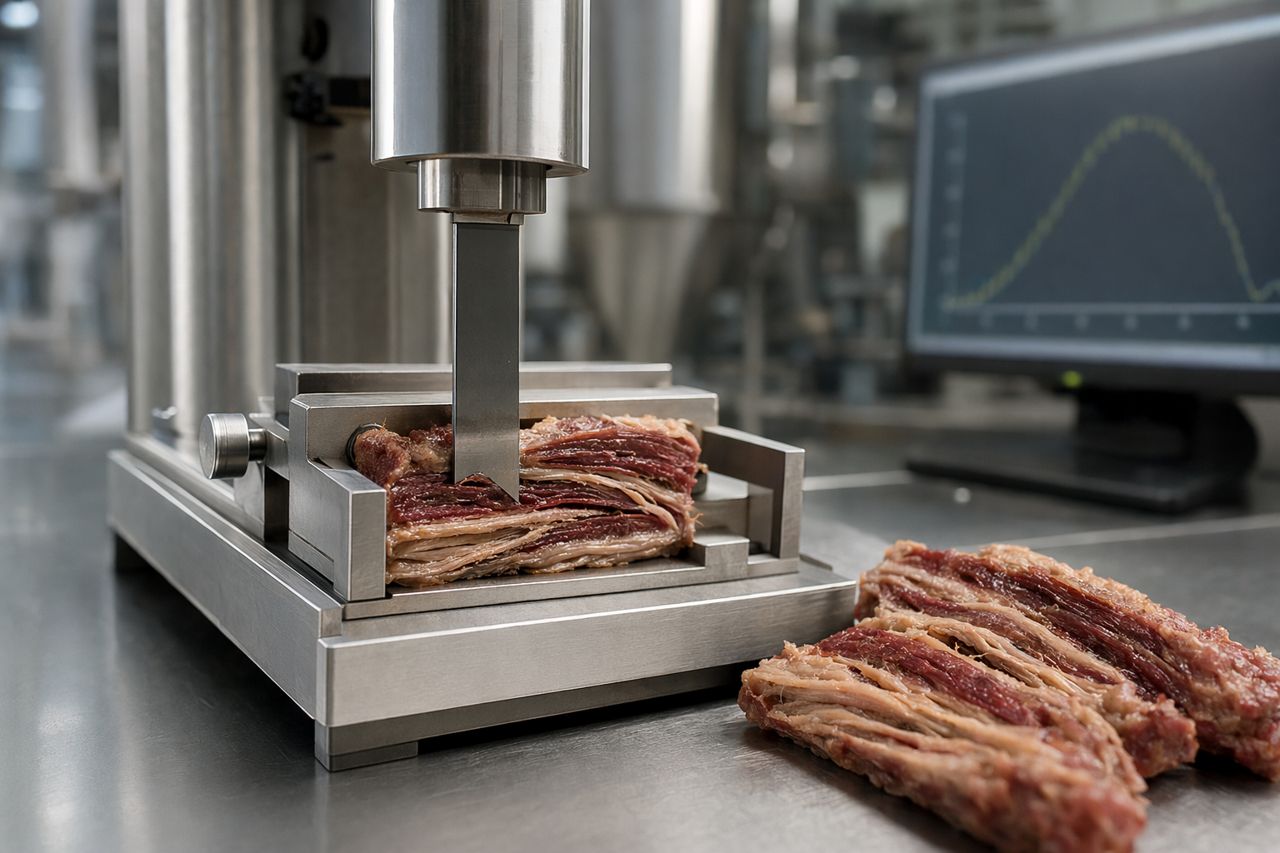
2. Blade shear and cut resistance
Blade shear is essential when the consumer experience depends on how the product cuts: burger bite-through, strip tearing, diced formats, or whole-cut slicing.
Track:
- Initial cut resistance
- Work required through the full sample depth
- Smooth versus jagged fracture behavior
- Orientation effects in extruded or laminated material
- Changes after cook, hold, and reheat
For aligned plant-protein structures, always test both with and across the fiber direction. A material that looks fibrous may still behave isotropically under the blade. The difference between parallel and perpendicular cut behavior is often one of the clearest indicators that shear alignment and network setting are working together.
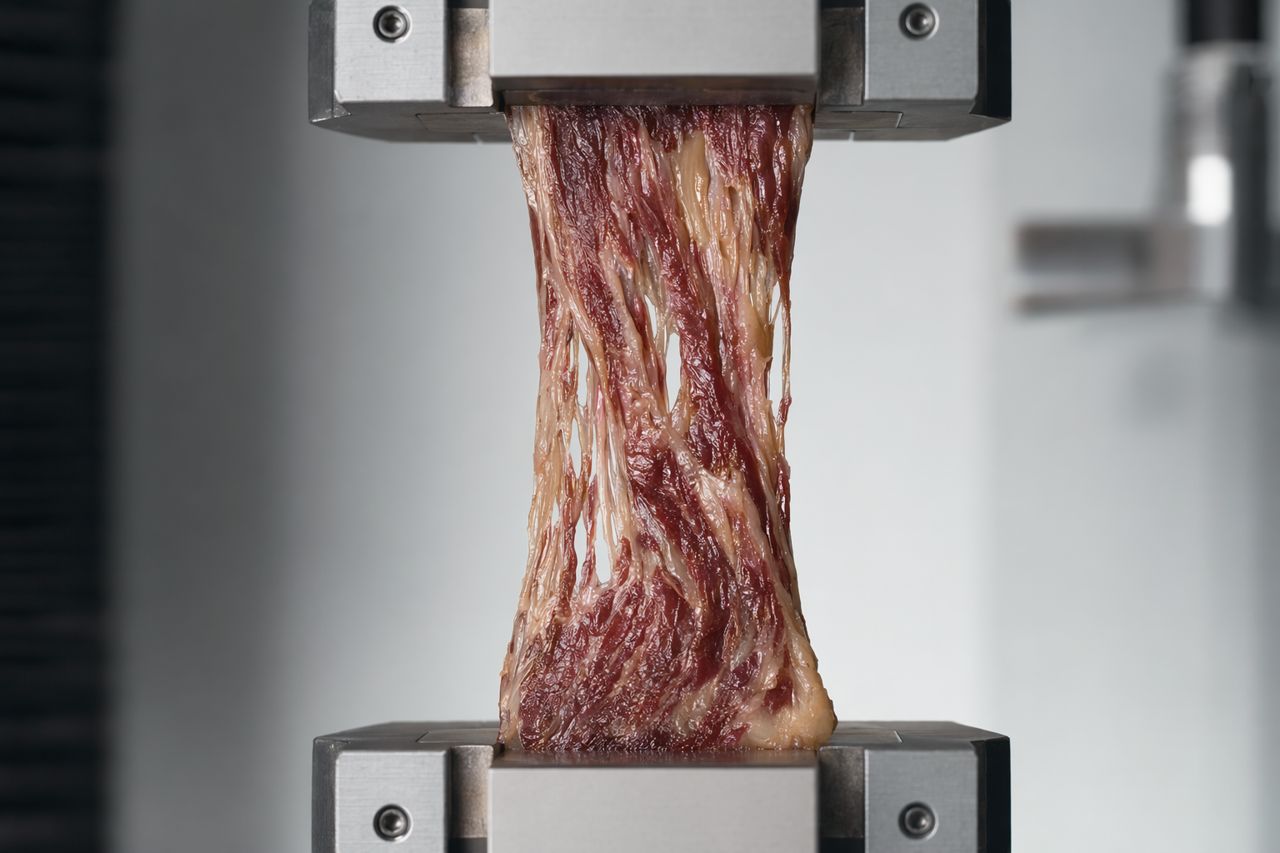
3. Tensile and fiber pull testing
Tensile testing is underused in plant-based meat R&D, but it is one of the most direct ways to evaluate fibrous formats. It can reveal whether strands are bonded, weakly hydrated, brittle, or too elastic.
Track:
- Maximum pull resistance
- Extension before break
- Fiber separation pattern
- Clean strand pull versus clumped failure
- Orientation-to-orientation variation across the sample
This is where enzyme selection and process timing matter. Crosslinking, controlled protein modification, and hydration management can all change how fibers hold under extension. The target is not maximum strength; it is the correct failure mode for the product format.
4. Puncture testing for crust-interior systems
For coated, filled, or layered products, puncture testing helps separate surface structure from interior bite.
Track:
- Surface break force
- Distance to rupture
- Interior resistance after puncture
- Difference between fresh-cooked, held, and reheated states
- Coating-to-core interaction when moisture migrates
This is especially useful for nuggets, tenders, and hybrid structures where the exterior can mask a weak core during informal cutting tests.
5. Stress relaxation and hold behavior
Some plant-based meat systems feel firm at first contact but collapse or gum during chewing. Stress relaxation testing helps quantify how the matrix behaves while held under deformation.
Track:
- Force decay during a fixed deformation hold
- Speed of structural relaxation
- Residual resistance after the hold period
- Sensitivity to temperature and hydration state
This test is valuable for detecting over-hydrated proteins, weak binder networks, and enzyme treatments that soften the matrix beyond the desired bite window.
6. Cyclic compression for chew-down simulation
A single compression can miss what happens over repeated bites. Cyclic compression can show whether the matrix fractures progressively, densifies, or rebounds too much.
Track:
- Firmness loss across cycles
- Recovery between cycles
- Progressive crumble or paste formation
- Differences between chilled, cooked, and reheated samples
Use cyclic testing when sensory panels report terms like “mushy,” “rubbery,” “pasty,” or “dry after chewing.” Those descriptors usually reflect structure evolution, not just first-bite firmness.
Pair texture data with process conditions
Texture analyzer results become much more powerful when each data point is tied to process context. For plant-based meat manufacturing, the same formulation can behave differently depending on hydration order, shear history, thermal exposure, residence time, cooling rate, and hold conditions before forming.
Capture at minimum:
- Protein source, lot, and pre-treatment history
- Hydration sequence and rest time
- Mixing energy and order of ingredient addition
- Enzyme addition point and contact window
- Extrusion or forming temperature profile
- Cooling and setting conditions
- Cook method used before testing
- Sample orientation during cutting or pulling
This is where R&D teams often find the real scale-up constraint. A promising bench texture may depend on a narrow hydration or temperature window that the production line cannot hold consistently. The earlier that window is measured, the easier it is to adjust the enzyme system, binder strategy, or process sequence.
Interpreting enzyme effects through texture analytics
Enzymes can influence plant-based meat texture in several ways: building protein networks, tuning hydration, modifying viscosity, improving strand integrity, or adjusting the interaction between protein, starch, and fat phases. The correct texture analyzer test depends on the intended mechanism.
Use this directional map:
| Formulation goal | Texture analyzer signal to watch | What it may indicate |
|---|---|---|
| More cohesive patty bite | Higher compression cohesion without rubbery recovery | Network formation is improving rather than simply hardening |
| Cleaner cut in strips | More controlled blade shear curve | Fiber alignment and binding are becoming more uniform |
| Better pullable fibers | Higher tensile extension with strand separation | Fibers are connected enough to pull without clumping |
| Less mush after cook | Lower collapse in cyclic compression | Hydration and network setting are more stable under heat |
| Reduced brittleness | Lower abrupt fracture, better deformation before break | The matrix is less prone to dry snap or weak-phase separation |
| Improved reheat texture | Smaller shift between cooked and reheated tests | The structure is more tolerant to thermal cycling |
The key is to compare the full curve, not only the peak. Two samples can share similar maximum resistance and still produce very different eating textures.
Build a practical R&D test plan
A useful plant-based meat texture program does not need dozens of methods. It needs the right few, applied consistently.
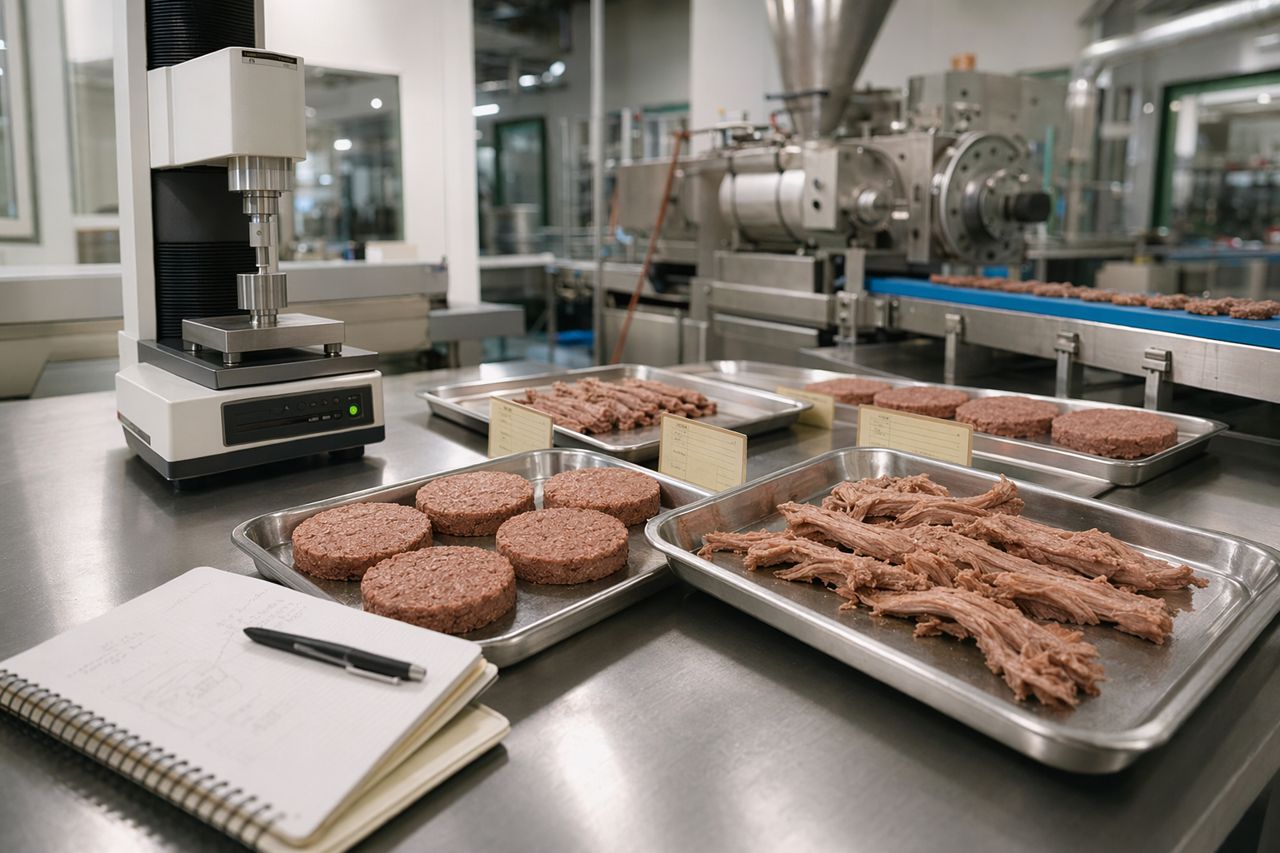
For burgers and grounds
Prioritize:
- Compression profile
- Blade shear after cooking
- Cyclic compression for chew-down
- Cook loss and dimensional change as companion data
Decision focus: cohesive bite without dense rubberiness, controlled crumble, and repeatable cooked texture.
For strips, shreds, and pulled formats
Prioritize:
- Tensile fiber pull
- Blade shear with and across fiber orientation
- Compression after hydration and cooking
- Visual fiber separation scoring alongside instrument data
Decision focus: aligned strand integrity, pull-apart behavior, and minimized paste-like failure.
For nuggets and coated systems
Prioritize:
- Puncture testing
- Compression of the core after coating removal when needed
- Reheat comparison
- Moisture migration checks after hold
Decision focus: stable interior bite, coating-compatible structure, and reduced collapse after holding.
For whole-cut analogues
Prioritize:
- Directional blade shear
- Tensile testing by layer or fiber axis
- Compression-relaxation
- Thermal cycle comparison
Decision focus: anisotropic bite, layered resistance, and structure retention after cook and rest.
Common texture analyzer mistakes to avoid
Testing only room-temperature samples
Plant-based meat is rarely eaten or processed at one temperature. Test chilled, cooked, held, and reheated states when those states are relevant to the product.
Ignoring sample orientation
Extruded and laminated materials are directional. If orientation is not controlled, the data will look noisy even when the material is consistent.
Optimizing for maximum firmness
Firmness is easy to increase. Good bite is harder. Watch cohesion, recovery, fracture mode, and chew-down behavior.
Comparing curves without process records
Texture differences may come from hydration timing, thermal history, or shear—not the enzyme or ingredient change under review. Record the process details that shape the structure.
Letting sensory and instrument data drift apart
Texture analyzer results should be anchored to sensory language. If the panel says “fibrous but dry,” the test plan should include both directional pull behavior and cooked-state moisture stability proxies.
What Enzymefusion helps manufacturers solve
Enzymefusion supports plant-based meat teams that need more than a catalog ingredient. We help connect enzyme selection to the texture mechanics that matter on the line: protein network formation, fiber integrity, hydration behavior, cooked-state stability, and repeatability across scale.
Typical project questions include:
- How do we increase cohesion without making the bite rubbery?
- How do we improve strand pull in a high-moisture extruded base?
- How do we reduce cooked collapse in a patty or nugget core?
- How do we maintain texture after freezing, thawing, and reheating?
- How do we translate bench texture improvements into production specs?
If your team is building a texture analyzer test plan—or trying to interpret why a promising formulation changes at pilot scale—Enzymefusion can help map enzyme options to the right mechanical targets.
Request a quote
Share your product format, protein base, current process, and target texture. We’ll review the manufacturing context and recommend an enzyme approach suited to your formulation and scale-up path.