Build plant-protein texture with more control
Strandwright supplies enzyme systems for R&D and production teams developing plant-based meat from soy, pea, wheat, and blended protein bases. We help factories tune bite, bind, water management, and slice integrity without turning scale-up into guesswork.
If you need an enzyme supplier for plant based meat manufacturing that speaks formulation, extrusion, hydration, and plant-floor variability, start here.
Enzyme workflows for firmer, juicier meat analogues
Plant-protein texture is rarely solved by one ingredient change. Bite, fiber definition, purge, marbling stability, and cook yield are shaped by protein quality, hydration order, shear, temperature profile, fat phase, salt system, and hold time.
Strandwright builds enzyme recommendations around those variables—not around generic catalog language.
We support:
- Structured mince and grounds with cleaner particle bind and reduced crumble
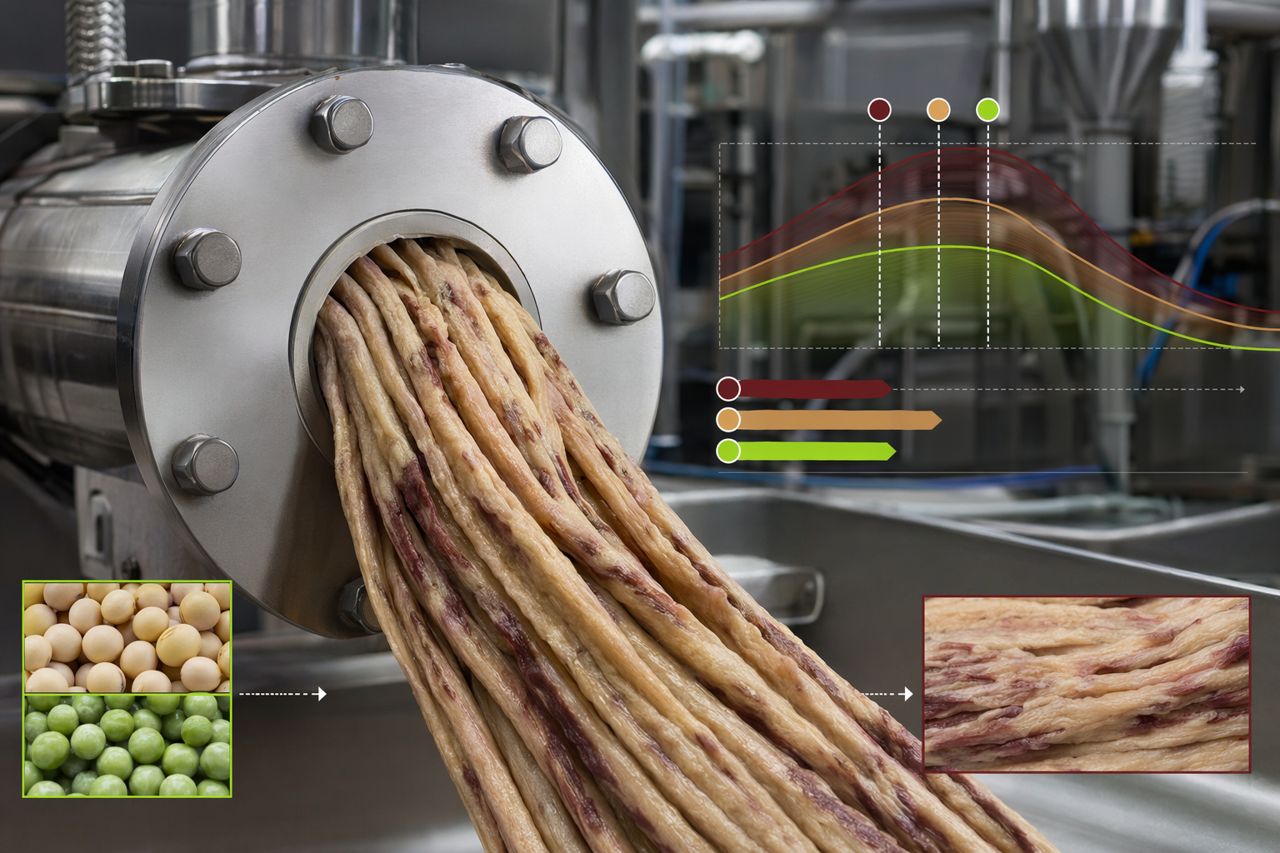
- Extruded strips, chunks, and shreds with stronger aligned fiber networks
- Burger, sausage, and nugget formats requiring bite without rubberiness
- Hybrid soy-pea-wheat systems where protein behavior shifts batch to batch
- High-moisture extrusion and post-extrusion forming with defined texture targets
- Marbled or laminated systems that need stable water and fat distribution
What enzymes can help control
Binding and bite
Crosslinking and protein-modifying systems can improve cohesion, sliceability, and chew when plant proteins lack native structure. Strandwright helps define where the enzyme belongs in the process: pre-hydration, mixing, forming, resting, extrusion-adjacent steps, or post-structure setting.
Water hold and juiciness
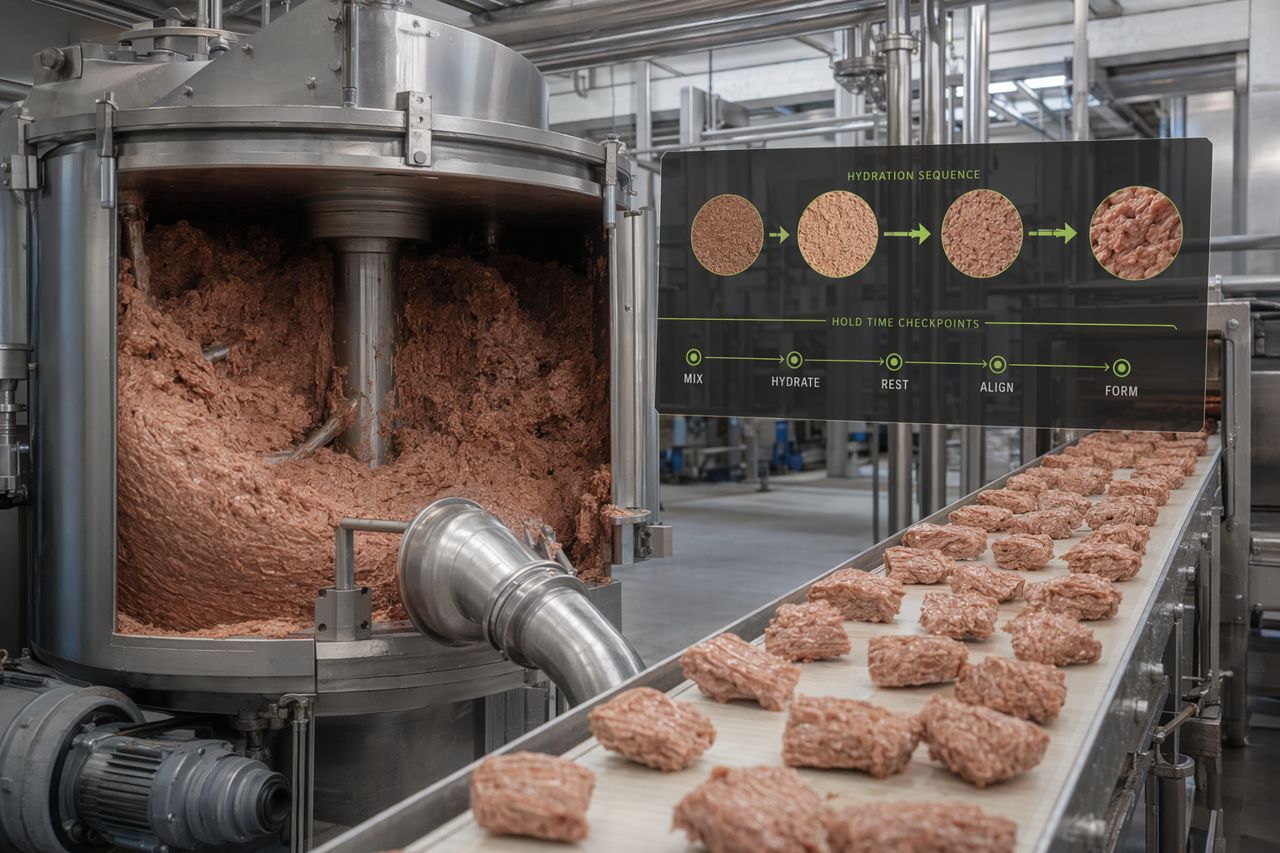
Moisture is not just an inclusion rate. It is a distribution problem. We help R&D teams manage hydration sequence, residence time, protein exposure, and enzyme timing so the finished texture holds water through forming, chilling, cooking, and reheating.
Fiber formation and strand integrity
For high-moisture extruded products, small formulation shifts can alter melt behavior and strand formation. Strandwright works with your team to test enzyme-compatible windows that support alignment without excessive firmness, gumminess, or surface dryness.
Scale-up repeatability
A bench texture that works once is not enough. We focus on workflows that survive larger mixers, longer transfer times, thermal lag, ingredient variability, and production holds. The goal is a texture system your operators can run, not just a prototype your lab can admire.
Built for R&D directors and factory teams
Strandwright is not a flavor house, not a finished-product brand, and not a broad food-ingredient marketplace. We are focused on enzyme-enabled texture engineering for plant-based meat manufacturing.
You come to us with:
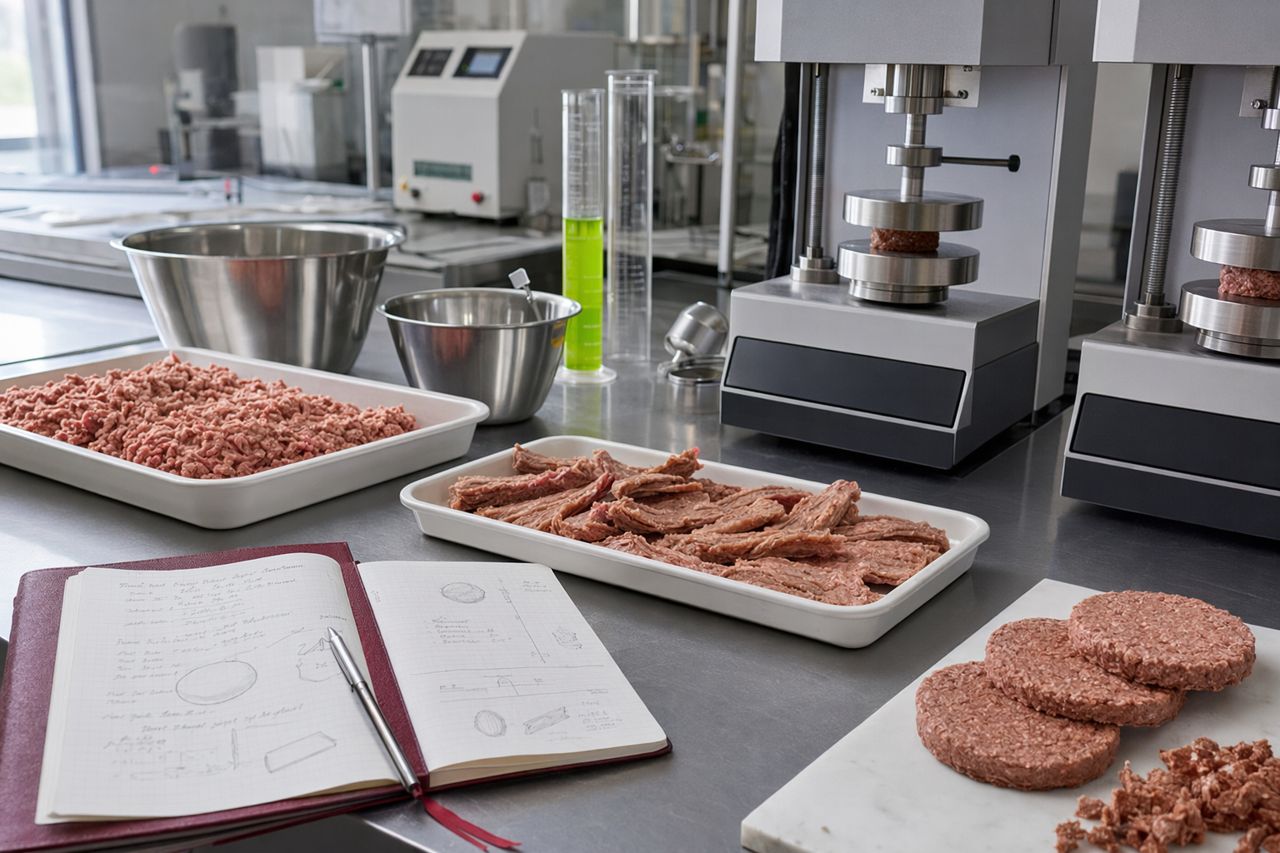
- A target texture benchmark
- Current protein sources and inclusion ranges
- Process map from hydration through pack-out
- Constraints around label, allergen position, thermal profile, and cost-in-use
- Failure modes: crumble, dryness, weak bite, rubbery chew, purge, poor slice, texture drift
We return practical enzyme options, use guidance, and trial logic that your R&D and operations teams can test without rebuilding the entire formula.
Common production challenges we support
“The bench sample works, but the pilot run falls apart.”
Scale changes shear history, hydration kinetics, and exposure time. We help identify where enzyme timing and process sequencing need to move as batch size increases.
“The bite is firm, but the product is dry.”
Overbuilding protein networks can reduce perceived juiciness. Strandwright helps balance set strength with water mobility and fat-phase integration.
“Pea protein gives us variation we cannot fully control.”
Different protein lots hydrate and shear differently. We help build enzyme trials around realistic raw-material variation instead of idealized samples.
“The product slices well cold but crumbles after cooking.”
Cold strength and hot-eat performance are different targets. We support enzyme selection and process windows that account for thermal stress during final preparation.
How we work
-
Define the texture target
Bite, chew, strand definition, purge, slice integrity, and cook performance are documented before enzyme selection. -
Map the process window
We review hydration order, mixing energy, temperature exposure, residence time, forming pressure, extrusion profile, and hold conditions. -
Recommend enzyme pathways
We suggest enzyme types and trial ranges aligned with your protein base, finished format, and factory constraints. -
Support trial design
Your team receives a practical comparison plan to isolate what the enzyme is doing, not a vague “try more or less” instruction. -
Prepare for scale-up
We help translate lab observations into pilot and production considerations: addition point, dispersion, hold sensitivity, thermal exposure, and operator control points.
Why Strandwright
- Plant-protein specific thinking for soy, pea, wheat, and blended systems
- Factory-aware recommendations that consider mixers, extruders, formers, chill times, and line speed
- Texture-first support built around measurable product outcomes
- Concise technical communication for R&D, procurement, QA, and operations
- Quote-based supply for commercial and pilot-scale manufacturing needs
Request a quote
Tell us what you are making, what texture problem you need to solve, and where you are in development. Strandwright will review your application and respond with the most relevant enzyme options for your plant-based meat process.
Request a quote using the on-site form
Include, if available:
- Protein base: soy, pea, wheat, fava, mycoprotein blend, or other
- Product format: burger, mince, sausage, strip, chunk, shred, nugget, sliced item
- Process: cold forming, high-moisture extrusion, low-moisture extrusion, lamination, post-extrusion forming
- Current issue: crumble, dryness, purge, weak bind, rubbery bite, poor fiber, texture drift
- Target production stage: bench, pilot, first commercial run, line optimization